
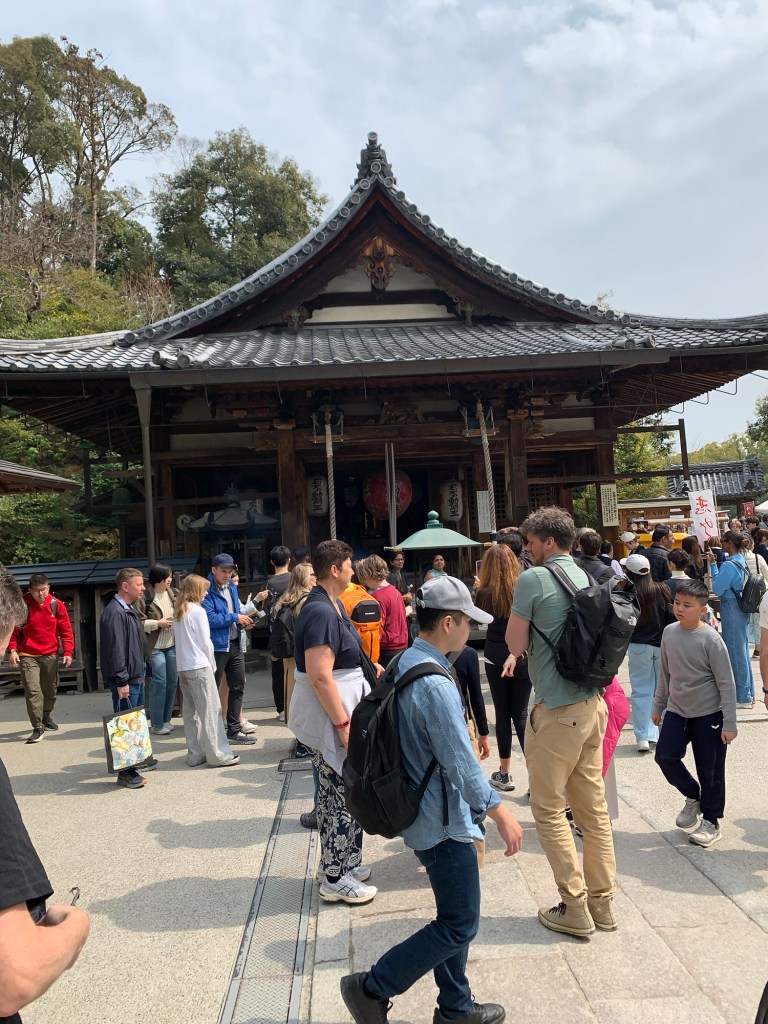
A Shinto shrine in Kyoto is a good place to practice eeling, not contemplation. Eeling is what M calls weaving your way along in a crowd. The Inari shrine (from 710 CE) dedicated to the god/goddess (early depictions are female, then in the 19th century she was drawn as male) of rice would be filled to the rafters with visitors, if there were rafters.
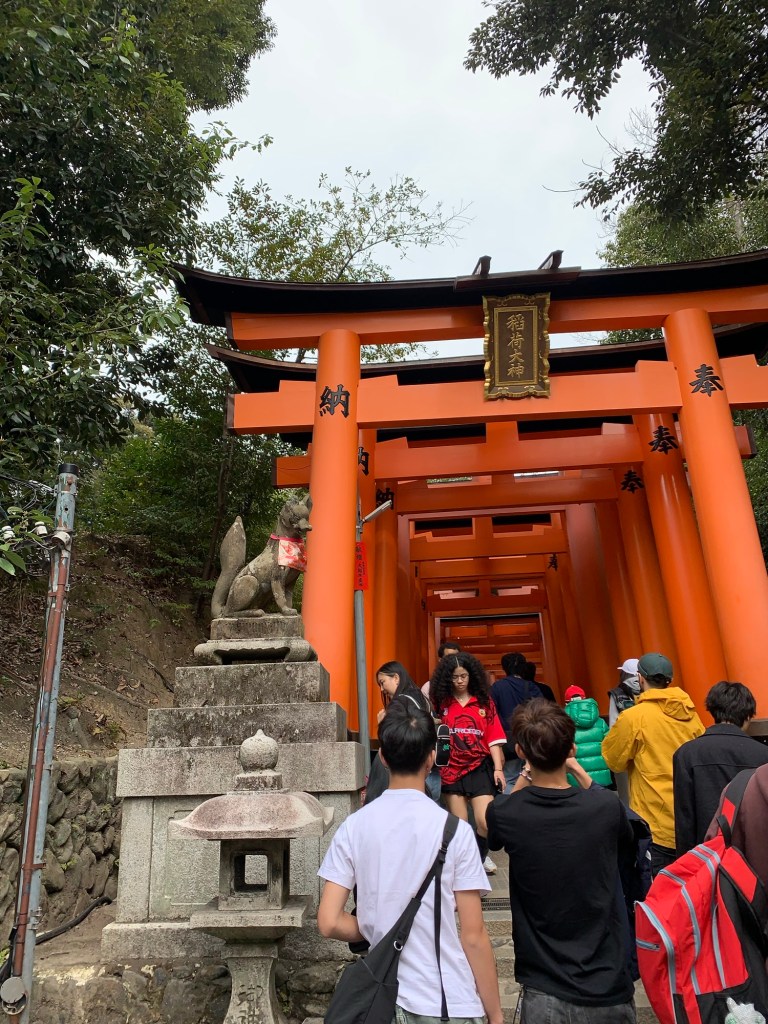
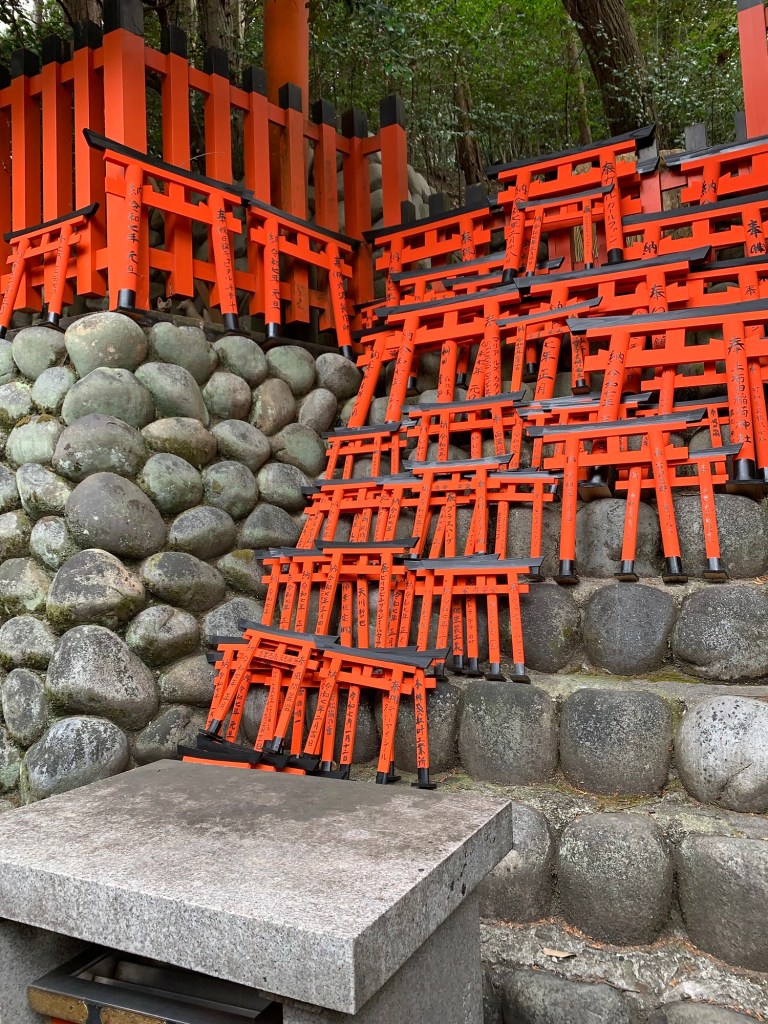
Instead there are Torii, vermilion structures consisting of two cylindrical wooden posts with an extra long cross bar on the top and a smaller crossbar somewhat below the first. These are mystical gates to welcome and appease the Kami, the unseen spirits who populate the natural world. Unlike Bali, with its gods and demons ever at war, Japan’s Kami are a varying balance of benevolent and indifferent, like nature, wrapped up in one package. You have to watch out for Yokai, the shapeshifters who are pranksters or malevolent spirits.
Our guide summarized the two coexisting religions of Buddhism and Shintoism: Buddhism is for somber occasions and Shinto for joyous times. Give up your attachments like Buddha but don’t forget to party with Inari for a good harvest. Toast her with sake! The 10,000 Torii have accumulated over the years as thank-you’s to Inari for granted wishes. Her familiars are stylized foxes, called Kitsue. The stone Kitsue had magical symbols in their mouths like a sheaf of rice or a key. Worshippers had draped the Kitsue in cloth bibs. They reminded me of what happened to Olaf when he strayed too close to a basket of laundry.

JG and I washed our hands before entering the shrine and then we staggered along in a huge gaggle of people. JG was annoyed by this experience. People jostled him and he tried to avoid stepping on others’ feet. As a smaller person, my experience eeling was a little different.
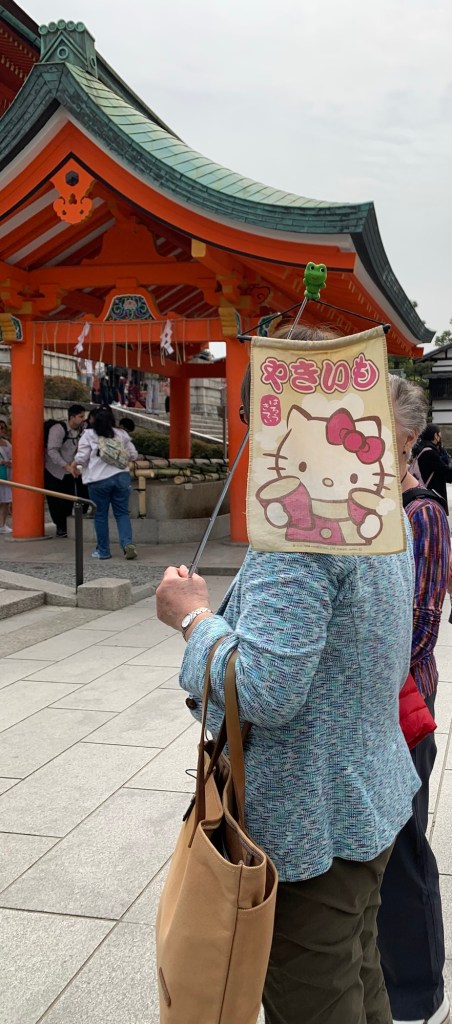
I kept one eye on our guide, who was holding a “Hello Kitty” banner, and one eye on my spouse. I thought the people-watching was interesting. Though I didn’t get stepped on, a Westerner’s Fjållråven daypack knocked my glasses off when he turned around suddenly. Was that the Arctic Kitsue sending me a message?

“Overtouristed” muttered our guide into our earpieces, biting the hand that feeds her. JG: “I felt like one of those rats in the overcrowding experiment. I felt like biting someone’s tail.”
What we were supposed to be doing while eeling was praying. Something like: O Great and Beneficent Spirit, grant me this my dearest wish, for _____. Stands in the shrine area sold good luck charms, lucky number scrolls, fortune-telling stones, and stuffed Kitsue to go.
There were opportunities to write out your wish and leave it at the shrine: ¥200 for a small wish and ¥700 for a big wish. We could read what others had wished for in English: health, lasting love, and prosperity came up frequently. One supplicant wished for a good score on the LSAT. No one wrote about rice.

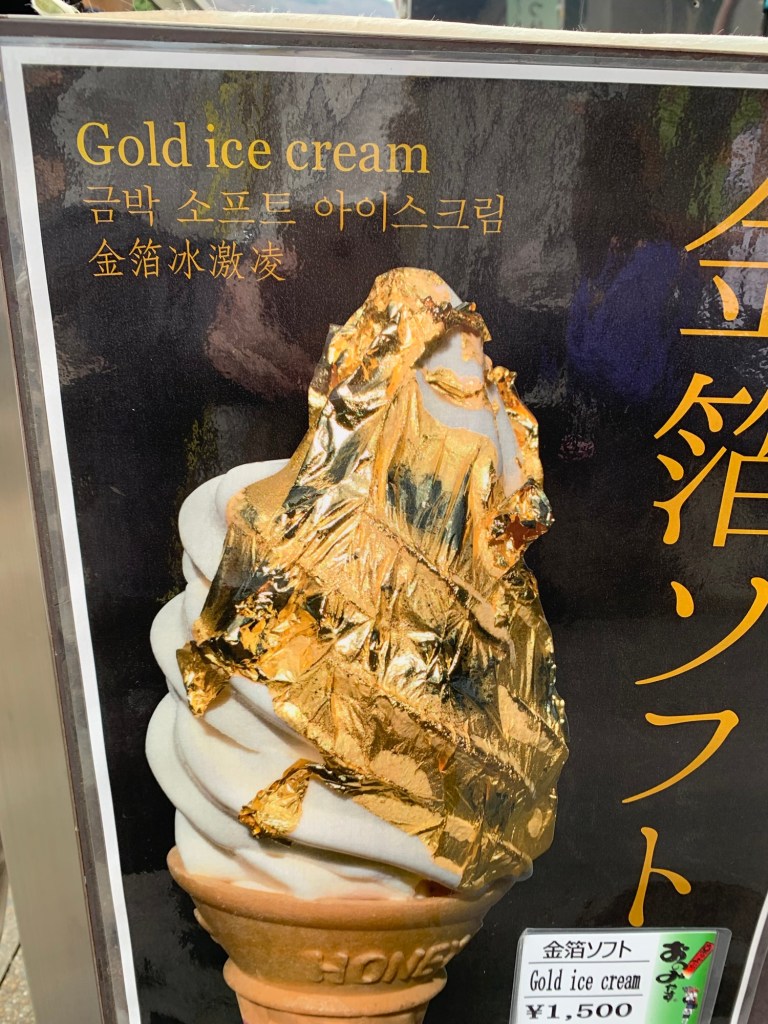
As an aside, the Japanese eat some foods I can’t imagine putting to my lips. I have on occasion accidentally worn some ice cream on my shirt. This gold-coated soft serve ice cream may look fancy, but it’s best not to confuse one’s dessert with one’s jewelry.
 JohnandJanet'sJourney
Though the shrine sounds crowded, I love the dressed up Kitsue!
inquiring minds want to know what happened after eating the gold-leaf ice cream.
Love,
Shosh
LikeLike
I did not buy it. I might wear ice cream but I won’t eat gold. Inquiring minds may have a lick of my gold necklace when we return.
LikeLike
Gold is pretty inert, so it’d probably pass on through, right? Leaving one with sparkly stool?
It doesn’t seem like a pleasant experience.
LikeLike
What a crowd scene!
I wonder what happened in the 19th century to turn the goddess into a god.
It seems very sensible to keep a backup religion for the good times, when you don’t want to foreswear earthly attachments. Especially because the kitsune are cute!
Do you think LSAT scores fall into the same theological category as rice?
LikeLike