Unnamed Nation

We visited this nation, stretching 1700 kilometers north to south and home to over 101 million people. It lies between Singapore and Hong Kong. It fought a bloody “War of Independence” from 1945, when the occupying Japanese left, to 1975. The USA sided with the South and led the charge against the North. Our family and many others protested against this war and wished for peace.  

Folk Costumes for Photos

Fifty years later, the country is firmly in the control of the Party. The plainclothes thought police are everywhere. That which might enhance a circumscribed life of earn and spend is nonexistent or strictly regulated. There is a food culture and a shopping culture. Religion, art, writing and music are controlled. This is the country that persecutes Buddhist monks and nuns for insufficient national unity. The beggars and hawkers have vanished  from the downtown streets. Security guards watch the public. No birds. No doggies. One bicyclist. No runners. One teen boy wore a sassy T-Shirt with the slogan “Make Money Not Friends.” Dangerous electrical wiring abounds.

Young people approached me to practice their English. Mostly young women smiled and wanted to say hello and a little conversation. A male film crew from Van Lang University stopped me on the “Book Street” (created in 2016) and asked to interview me in English. I then spoke on camera about how delicious and fresh the local cuisine was and about my fondness for Spring Rolls. 

Our Lady Cathedral is still fenced off, as it has been for years. No obvious work was being done. Compared with cathedrals like Saint Stephen in Vienna, where actual workers repaired the facade as we watched, we saw no construction. I think the Party disliked seeing all those brides posing in front of Notre Dame on Instagram. Better they should pose for photos in front of the Great One’s Mausoleum.

I am intrigued by the folk songs. They sound like Chinese folk songs. The song names are devoted to nature. No sad cowboys and no dogies. No long black veils. More like: “Addressing the Floating Clouds at Sunrise” or “Sea Mists Stretch over the Majestic Mountain.”

Without JG breaking trail for me, I had to fend off grabby men who wanted to guide or otherwise interact with me. Not a big deal. My walking companion Daphne was more flustered.

The white-haired western lady in the foreground is Daphne from Leicestershire, a former CPA who now resides in Victoria, BC. She asked if she could “tag along” with me because she felt unsafe by herself. I had GPS on my cellphone and felt confident getting around, so I played personal tour guide. She wondered where all the old people were. The retirement age keeps advancing. It used to be 50 for women and 55 for men. Now it’s 55 for women and 60 for men and will continue to advance. I saw no old people in the central city, either.

I did learn how to cross the street successfully. There are breaks in the flow of motorbikes and vehicles and signals are either red or absent. I used sweeping gestures and eye contact to wade through the traffic at a constant pace. 

Notre Dame and Daphne

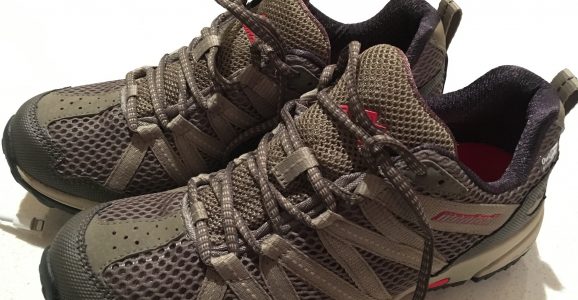
We visited a Taoist temple. I had watched as a lady burned play money for her deceased husband to use in the spirit world. I told my husband I’d be sending him sunblock, wool socks, and hiking boots for use in the Hereafter. 
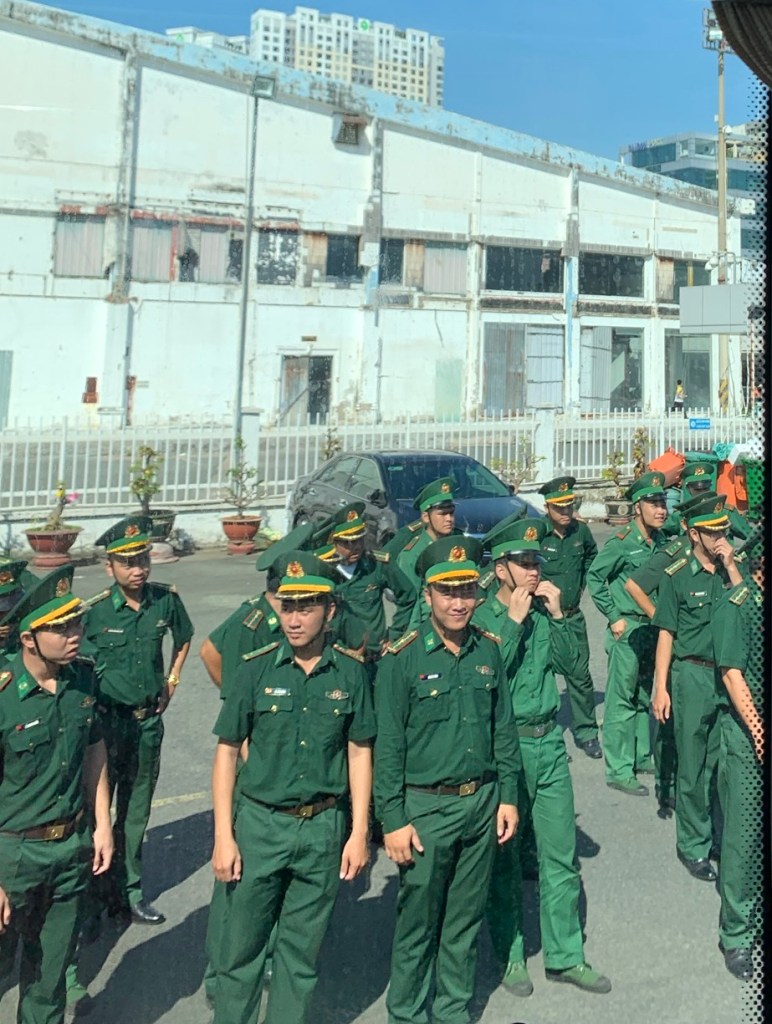
The People’s Army Musters

There used to be chinks in the wall around the people. The government had not cracked down on every single aspect of culture. Today the opera house hosts a sound and light show. 

Nibbles

We visited a museum dedicated to the local War that ended 50 years ago. Here in English, tourists could read about and see photos of the artillery, the prisons, and the atrocities of war. I was ashamed of my country’s devastation of this country. 

I am unmoved by the joy of shopping here. This is a land of merchandise created by a biddable non-union workforce. Understand the tiers. Many designer goods, the expensive premium goods, are made in this country. Fake designer goods circulate as well. Knock offs are made to look like designer goods but without the label. Seconds are designer goods that have some flaw and can’t be sold at premium prices. Some tourists squeal with delight at the shopping here. Their ambition is to snag those fancy expensive-looking goods: shoes, clothes, handbags, etc. at steep discounts. I’m not the target customer; I’m the Target customer. I admire nice things but have no interest in spending the money to get them, nor in buying designer goods off price. 

Da Nang: Shir Hadash Lyre

I like handcrafts, but don’t want to buy any. I was taken in by a circle of ladies embroidering floral motifs on a tablecloth stretched on a hoop. The sales lady showed me a sample of the fine hand-stitched table linens. I bought one, which was delivered to me shrink-wrapped in plastic. When I opened the package later, I found machine-stitched embroidery, not the handiwork of a huddle of ladies. I had been sold an attractive back story for a sewing machine’s product. I guess it was a knock off of designer goods. 
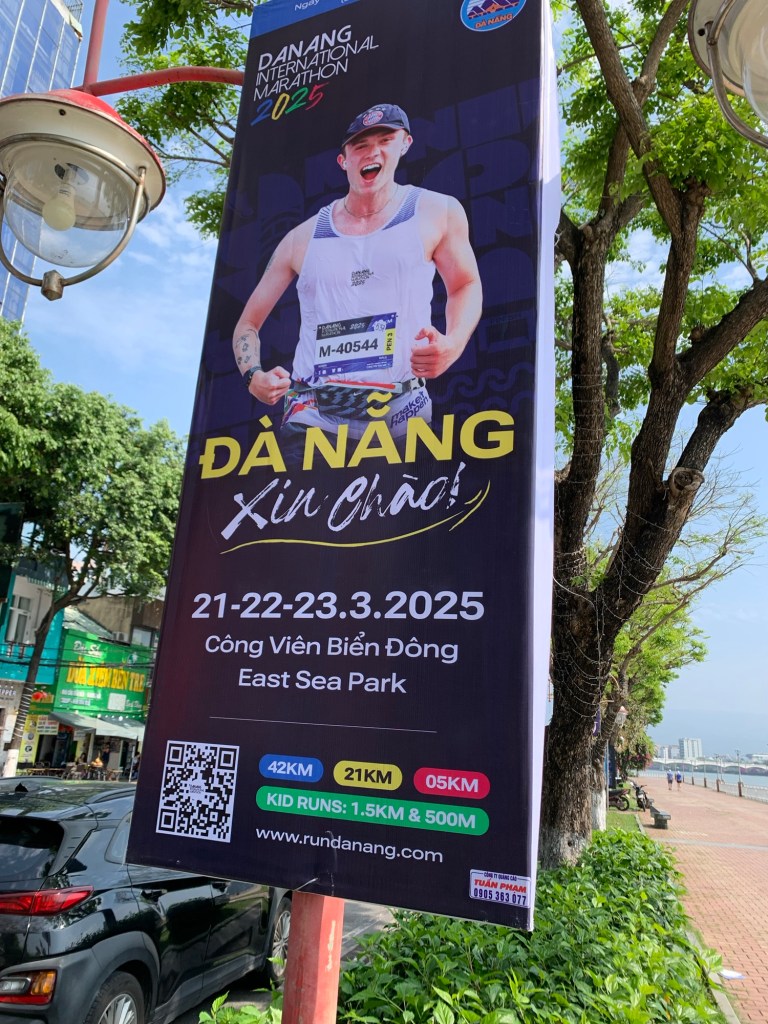
Next weekend Da Nang hosts a marathon

Singapore

DIY Bowls

What a contrast, going from Bali to Singapore. I like this well-ordered nation of 5.8 Million residents, but I wouldn’t want to live here. I am not bothered by the strict policies on public behavior. Plainclothes officers patrol the public areas and are empowered to demand a fine on the spot for several offenses like littering, spitting, playing loud music, eating or drinking on MRT (Mass Rapid Transit), not flushing a public toilet, not cleaning up after yourself. I notice that more restaurants, even snack bars and fast food, serve on real plates.

This city, like San Francisco, is constantly under construction. Singapore adds fill to the Singapore Strait and makes a new island and a new shoreline. So we’ve gone from chaotic grubby Bali to clean skyscrapers in Singapore. 

Singapore means “Lion City.” It has a long salad bowl history, tossing together Han Chinese, Malay, Indian and European. Most Singaporeans are of Chinese descent. I appreciate that there are four official languages in Singapore: English, Mandarin, Malay, and Tamil. A few times while shopping, I’ve asked the clerk, what languages do you speak? And the answers, with pride, have been English, Malay, and Chinese. 

We have gone from Balinese Hinduism to a Buddhist and multi-religious city.  It’s quieter about religious practice. 

Most people live in high rises. They shop in the basement level of the building. I have seen no bicycles. The only runners I saw were within the Botanical Gardens. Where Bali teemed with sculptures, spirits, people, motorbikes, and shouting, Singapore seems modern.  People are siloed in tall buildings. S. asked about the nice tropical beaches on Bali. Second-hand I can tell you that you can rent a chaise longue and a sun shade, have frosty umbrella drinks brought to you, and constantly engage with trinket vendors and other hustlers unless you hire your own personal hustler to tell the others to back off. In neighboring Singapore, you will probably not haggle, not even in the stalls of the Chinatown street market.  Taxi drivers are forbidden to cut side deals or take tips. People follow the rules or face fines, caning, or imprisonment. 

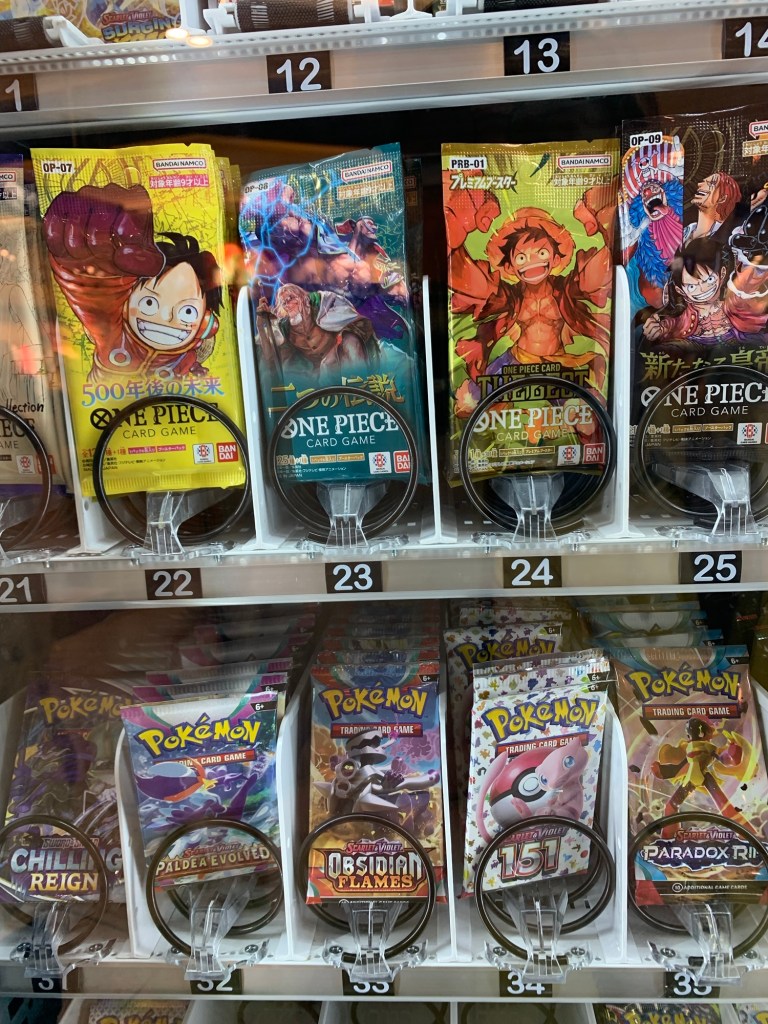
Vending Machine Has Collectible Cards

Curious about the swank casino many Aussies were visiting, I looked up the requirements for entry. Foreigners must present a passport. Singapore residents must pay S$150 per entry or S$3000 per year. Those on public assistance may not enter. Table games like blackjack have a S$25 minimum. Smart casual dress is required. It’s different from the loose rules in Las Vegas. 

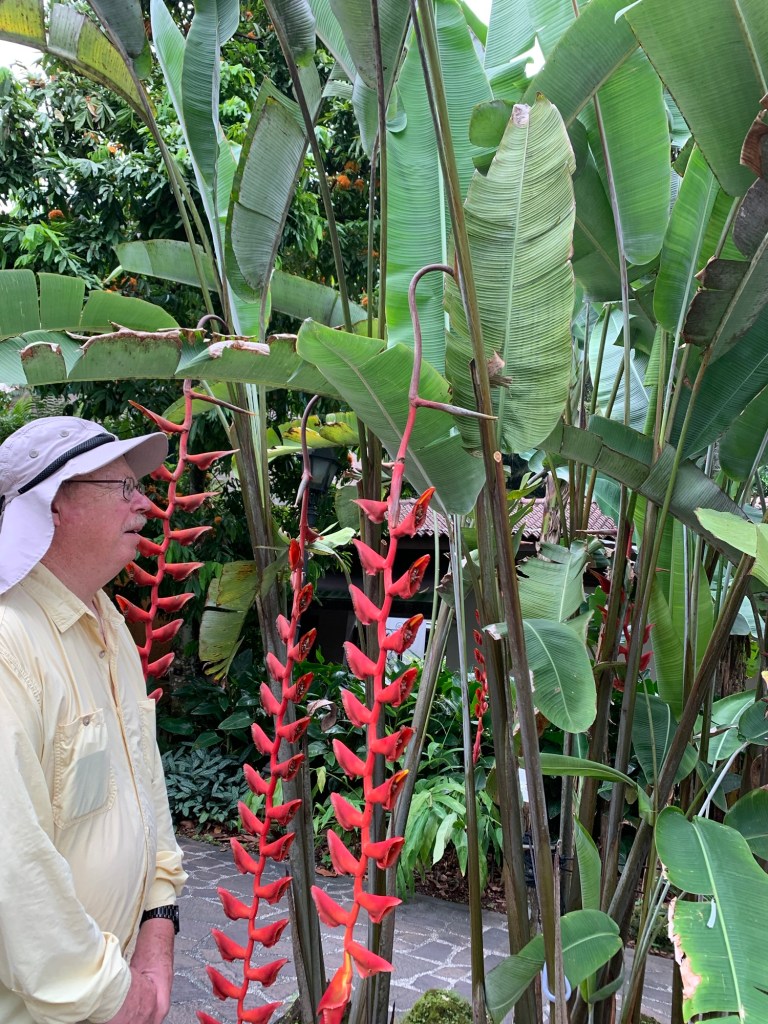
Heliconia

Bali: Civet Coffee

What story combines high-priced luxury goods, animal welfare, and — crowd favorite — poop? The story of civet coffee, coffee beans that have passed through the civet’s digestive tract! 

Palm Civet

According to oral history, the first cups of civet coffee were brewed because Indonesian farmers were not allowed to consume the coffee beans their Dutch overlords made them plant. So they collected coffee beans scavenged from civet excrement to brew coffee without breaking the Dutch rules. 

Then in 1991 Bule Tony Wild began the stampede toward civet coffee by proclaiming it a smoother, more healthful, and rarer kind of coffee that every coffee aficionado should try. The civet gut ferments the coffee beans to make the brew taste earthy and complex. Oprah promoted it on camera in 2003. As prices for the luxury commodity climbed, more Balinese jumped into civet-coveting and more foreigners jumped on the Civet Coffee Best Coffee Ever bandwagon. The market value for civet coffee is expected to reach $10.9 Billion by 2030. 

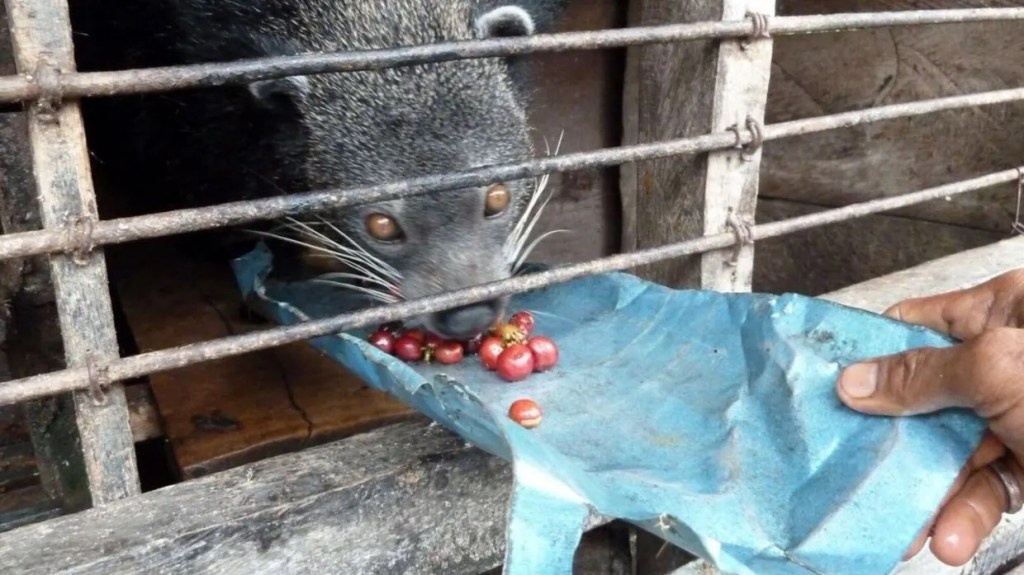
Caged Civet Eating Coffee

Many years later, Mr. Wild has become a prominent spokesman against civet coffee. Demand has caused civets to be caught, caged, and force-fed coffee beans. The sad solitary civets look miserable and suffer from caffeine toxicity. Marketers claim their beans are foraged from wild civet poo, but only a small fraction of their beans are acquired this way. See: https://www.thecivetproject.com/stopcivetcoffee

I wonder if it’s an Emperor’s New Clothes phenomenon. If it’s rare and a luxury, it must be tastier. Our Aunt Shirley drank Yuban or Folger’s perked coffee every day and scoffed at the fuss over fresh roasted and ground beans.  But certainly Indonesians would bristle at animal rights activists suggesting they free their civets and go back to picking beans from coffee bushes. As long as there is demand for the luxury commodity, civets will be trapped and kept for their coffee bean excrement. So Oprah, how about making it right?  Use your platform to denounce caging civets for coffee. 

Ubud, Bali, Indonesia

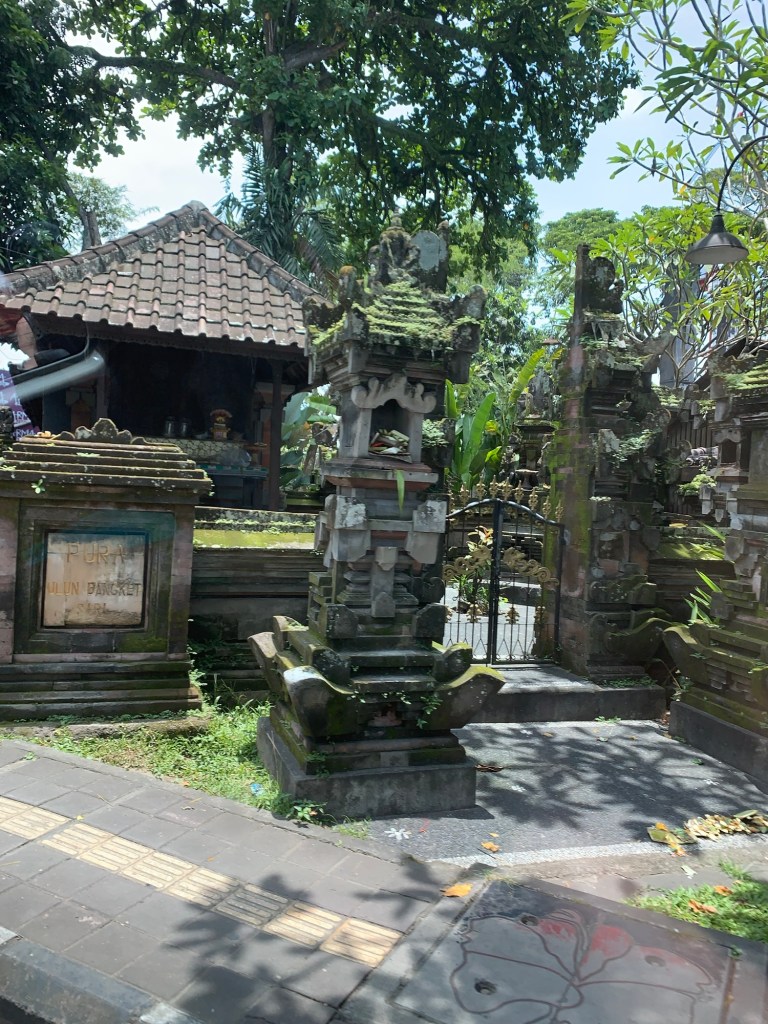
A Temple

Bali has its cheering fans, some of whom I met in Australia. I heard praise about the the culture, the cheap prices, and the natural beauty. We booked a tour to Ubud, reputedly one of fanciest areas of the island. Hmph. I was underwhelmed. I don’t appreciate what culture and cheap prices Bali offered me and I have higher standards for natural beauty.

Traffic is messy, water is non-potable, litter is ubiquitous, locals are guarded, tourists are rich, sanitation is limited, women are suppressed. This is such a patriarchal culture that Balinese women finally got the right to inherit property from their fathers or husbands in 2010. And I scoff at what once may have been natural beauty and now looks plumb worn out and sold out.

There are sculptures everywhere. Many represent guardian figures to ward off demons. A guardian is called bedogol. The demons must constantly be appeased with little offerings and thwarted with architecture. Demons only travel in a straight line, so Balinese add extra up and down steps through a gate and a half-height perpendicular wall to prevent demonic emanations from entering the housing compound. I understand the little trays of flower petals and rice, but nobody cleans them up when they’ve gone brown because that would offend the Gods of Rot.
There are street dogs who eat scraps and spread rabies. Our guides chaperoned us closely. I think if they lose someone the demons come for them. My guide, I. Vidnanya, told us many factoids: either true (Balinese men sit cross-legged and Balinese women sit kneeling, Bali always have good weather) or not (all land belongs to the village). He was distressed that I wasn’t taking enough photos.  Call me a California rice snob, but when I see workers harvesting rice by hand, I think it’s better done with a handy Kubota or similar. Not, golly, what a great photo op.

Barefoot Gardening in Denpasar
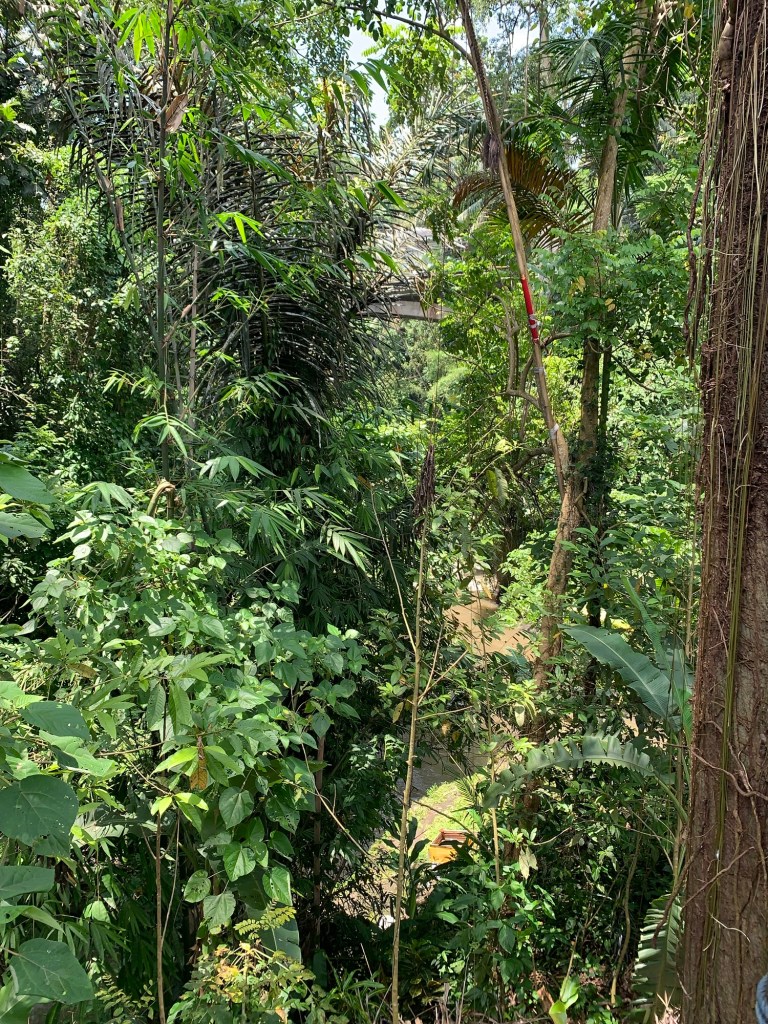
Tropical Jungle

I overheard one failed merchant transaction. Aussie, admiring a 12” by 12” floral painting: how much? Balinese Dad: 300 Australian Dollars. Aussie recoils.  Balinese Dad: 200 Dollars! Aussie shakes his head. Balinese Dad: for you, best price 100 dollars! Aussie backs away as if the painting were pursuing him. I learned to say tidak, which means no. 

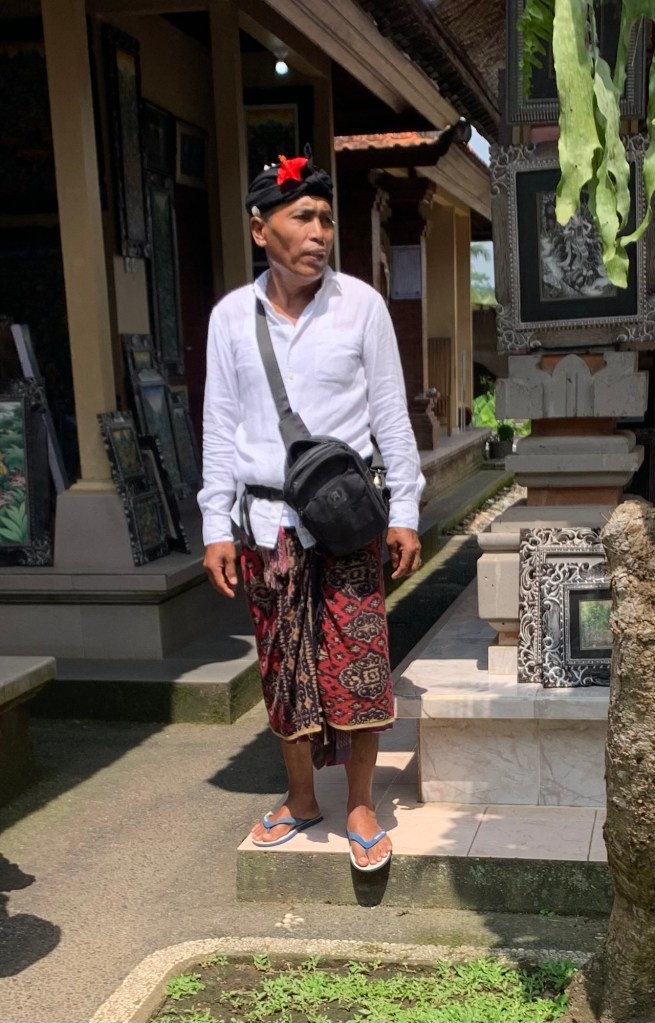
Balinese Dad dressed traditionally

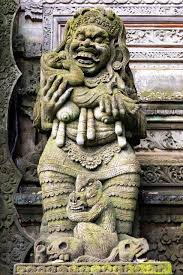
The demons are sculpted with exaggerated long canine teeth.

Rangda the Demon Queen

That’d be okay with me except the Balinese have a coming-of-age ceremony in which the teen’s canine teeth are filed down by a priest. It has something in common with our culture’s coming of age ceremony: both require facing down distant relatives who want to hug you. The belief is that the pointed canines invite evil thoughts and bad deeds. Also, it is considered more beautiful to have round even teeth. I think in the creative, spiritual world they may pray as they please, but subtracting perfectly good tooth enamel to fight evil spirits just invites dental problems. With age we all lose tooth enamel, which protects the teeth. I’ll work on being a better person who has sharp teeth. Not coincidentally, Balinese food seems soft and easy to chew: Nasi Goreng, green papaya salad.
Pointed Canines behind Mustache

Until I came to Bali, I thought my brothers made up the word “bunga ,” which describes the hyper running around state of a happy dog. Turns out “bunga” means “flower” in Indonesian, so “bunga bunga” is the plural. 

Our minivan had a guide and a driver. Our guide shepherded six of us: one couple each from the USA, UK, and Australia. The ones from left-handed roads applauded the driver a few times for skillful maneuvers to weave among motorbikes. I saw no stop signs and no working traffic signals. To stop traffic, someone steps out in the street waving a red flag. Although Bali claims not to have a caste system, though they imported other parts of Hinduism, the streets reveal a Balinese caste system. The wealthy, often Bule (foreigner), drive and are driven. The rest hop on motorbikes. Bule speak English, not Indonesian. Bule are the rich upper class.

Note Cell Phone in Hand
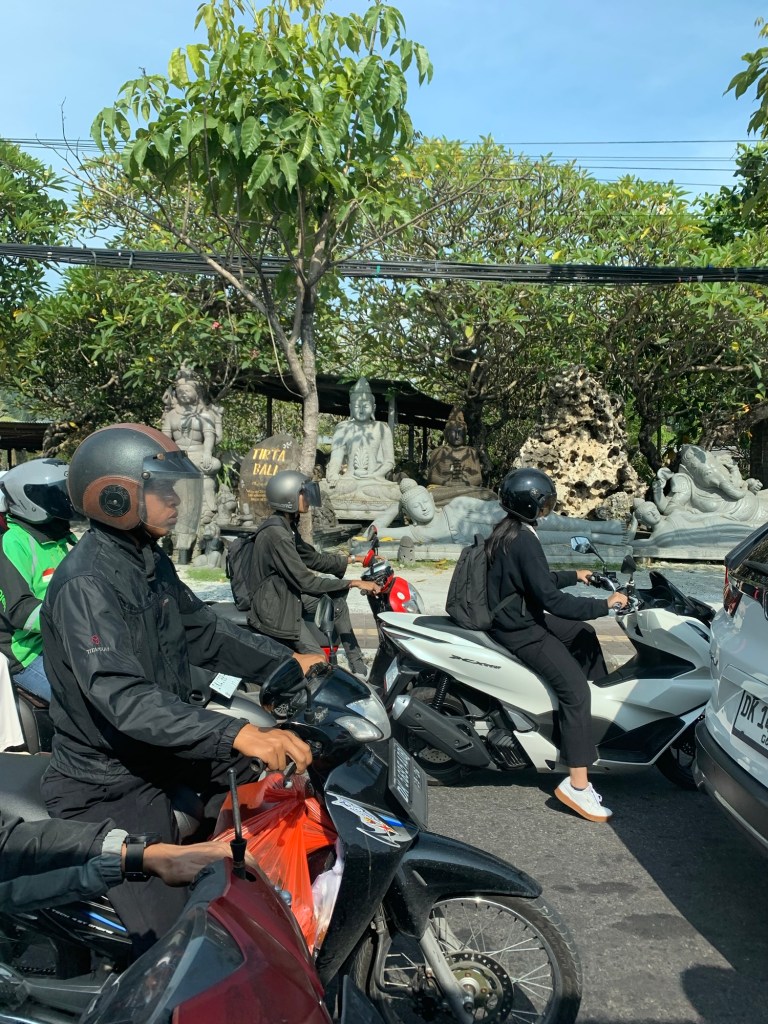
Denpasar Traffic
Art Gallery in Ubud
Denpasar Car Hire, Idol, Motorbike

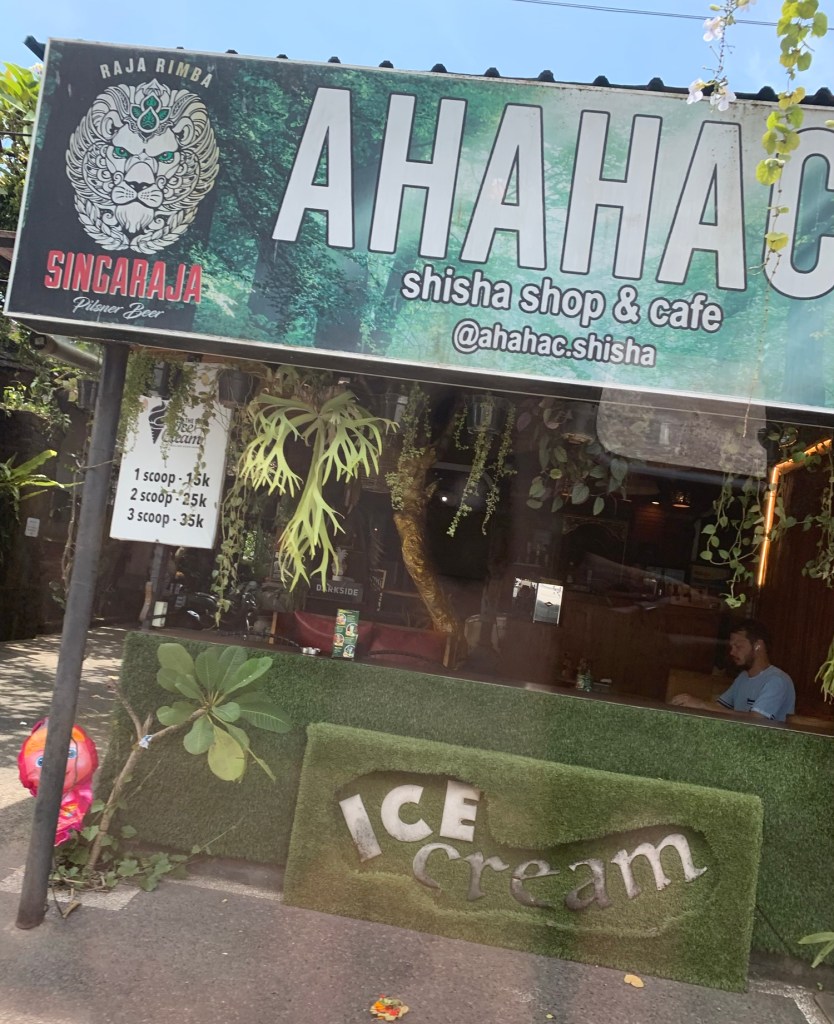
The combination of ice cream and shisha (flavored tobacco) caught my eye.

Shop Name sounds like a cough

Termites in the NT

Termite Mound

I have had some professional acquaintance with termites. Although others performed the termite extermination, I was the one to tell the afflicted tenant: sorry, but those insect bites on your legs are not from termites. Termites eat cellulose, not human flesh.

Nymph, Soldier, Worker Termites

Termites are socially organized into three castes. Most, over 90%,  are sightless, sexless, flightless, defenseless workers. Some, called soldiers, have mandibles to defend the colony against predators like ants. And a few, called alates, develop wings and sex organs. Then they fly off to mate and start a new colony. These are called reproductives. Your correspondent underlines the association of flight with sex and danger. Whee! The first rains of the wet season in November or December bring on the swarms of flying termites. Once they’ve left the security of the mound, termites become a convenient protein source for others, including people. The CSIRO, Commonwealth Science and Industry Organization, published a study showing greater diversity and abundance of lizards, birds, and insectivorous mammals in areas with greater termite populations. Termites are available year-round, not just in the plant-friendly wet season. 

Termites not only feed other animals, but also house them. Their mounds shelter other insects, birds, reptiles or small mammals. During wildfires on the Savanna, other animals dig an opening and hop in to wait out the fire. For the indigenous people, interior chambers of the mound, called carton, are a medicinal compound of earth and termite spit. They also use the mounds as a bush oven, slowly smoking their proteins like crocodile as the moist carton smolders.

Photo Credit: David Curl

CSIRO is introducing termites to overgrazed soils as a way to improve water retention and furnish nutrients. Instead of just mulching with plant matter, soil experts induce termites to eat the plant matter and then build mounds. This approach is still experimental. 

The lines echo the shape of the country, not like Cisco’s logo

I cannot stop admiring a society that promotes science.  That termite mounds are so well-studied speaks well of Australia. 

Merino Sheep

Shout out to the Sheep

Australia owes much of its prosperity to sheep. But slogans like: “Australia: we do sheep well!” Or “Australia is for 🐑!” were overlooked in favor of “Australia: riding on the sheep’s back” (1950’s).

The Merino breed of sheep found particular favor in Australia. Merinos originated in Spain, where their breeding was tightly controlled. Unpermitted Merino possession was a capital offense against the Spanish Crown. But by the 1770’s pairs of Merinos were gifted to European royalty. In 1797 the first Merinos arrived in Australia from South Africa, after enduring a perilous voyage.

Meanwhile, in the USA, Jefferson was trying his hand at sheep farming. See https://www.monticello.org/research-education/thomas-jefferson-encyclopedia/sheep/

A Merino craze was gripping our new nation: here might be a crop that’s easy to manage, needing only sheepdogs and twice yearly labor, at the lambing and the wool. Wool was greatly in demand as a wonder fiber for the newly constructed English textile mills and the price of Merinos skyrocketed. Jefferson got caught up in sheep speculation, hoping to profit but instead he got fleeced. What he thought was Merino wool was really just common Churro wool, though he spent a fortune putting his rams to good ewes.

Back in Australia, the imported Merinos flourished. They were hardy, adaptable to a drier or wetter climate, and selectively bred for good wool yields. They browsed on local grasses and faced few predators. Australia had a waiting market for fine wool in Great Britain before it developed its own woolen mills.

John MacArthur (1767 — 1834) is considered the father of the Merino wool industry.  He crossbred his flocks for genetic sturdiness and figured out how best to farm sheep without defined pastures.  Here, Skip! He also irritated the Governor of New South Wales, William Bligh, by not complying with Bligh’s orders during the Rum Rebellion of 1808, the only successful coup against the Crown. He also advocated anti-democratically in favor of an aristocratic well-capitalized ruling class while he made a fortune in sheep. His wife ran the farm while he stayed away from New South Wales while there was a warrant for his arrest there. After ten years the warrant was negated and he was allowed to return to NSW. In 1832 MacArhur was declared insane and he finished his life at home in Camden Park. (Note: Naomi Novik mentions MacArthur in her books.)

Retired $2 Bill: Merino and MacArthur

By 1815 Merinos were no longer trendy and pricey in the USA. One reason is that cloth made of Merino wool was deemed too fine a fabric for slaves to be wearing. Also, the Yankees in the North preferred rougher wool. So Merinos never caught on in the USA. 

Today the Australian trade association Woolmark is devoted to maintaining the purity and sustainability of virgin wool. I recommend buying clothes made of wool, when the sheep are well-treated. Just don’t put these wool garments in the dryer. 

Darwin, NT, AU

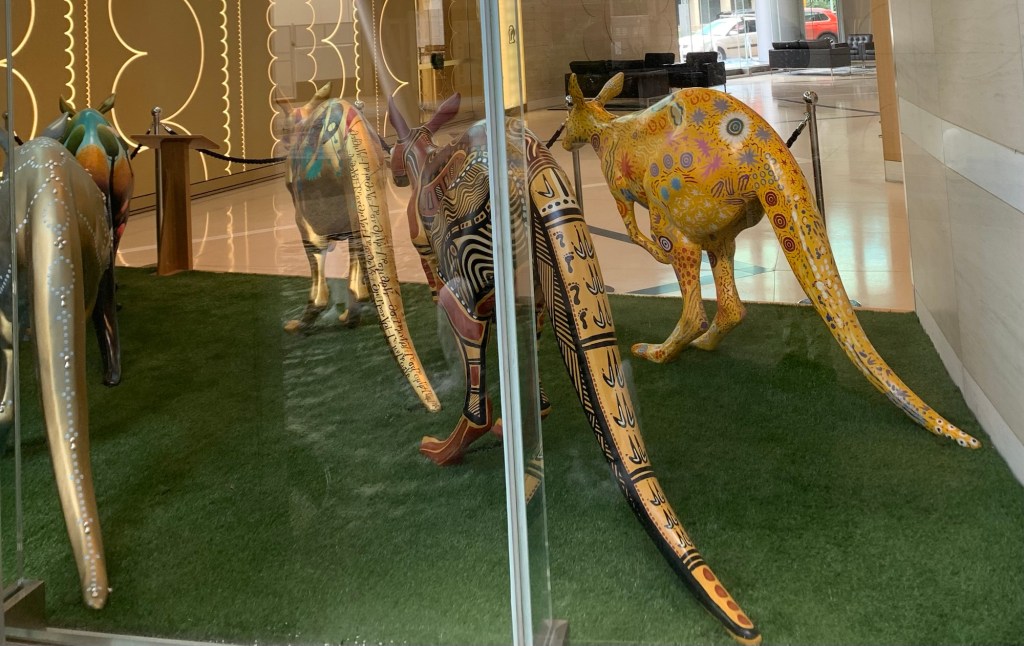
Painted Resin Kangaroos
Masked Lapwing

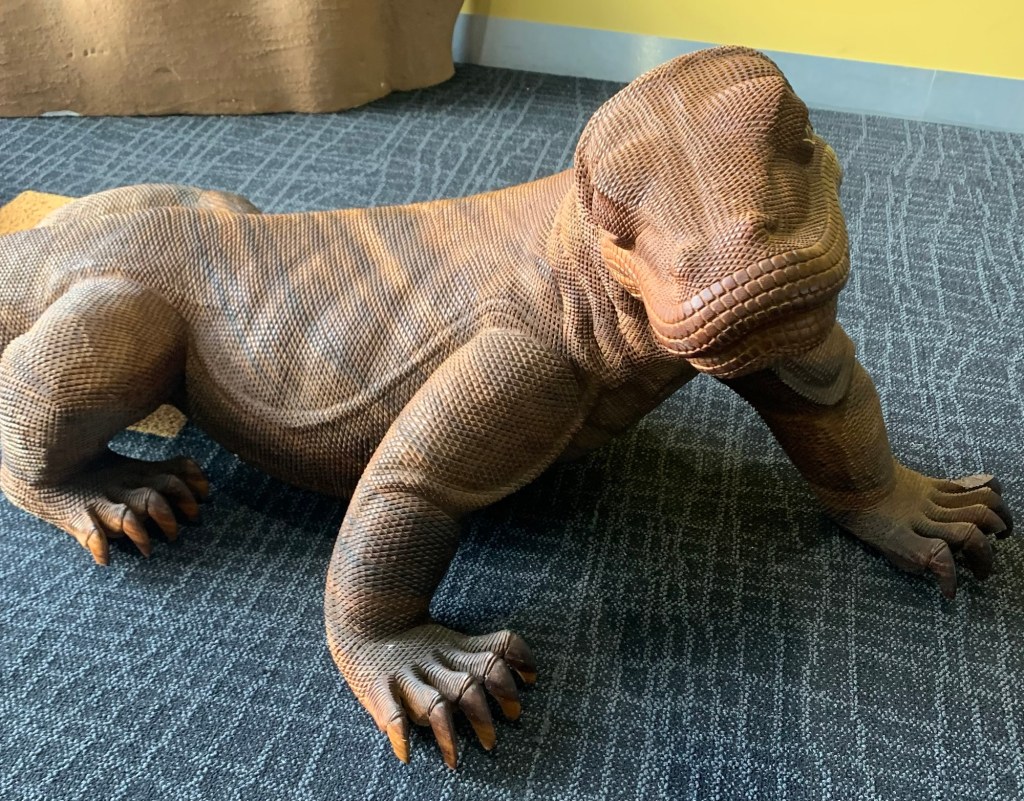
With a forecast of 37° C and high humidity, we canceled our planned tour of Litchfield NP to view the termite mounds. We are in the Northern Territory of Australia, pronounced “Top End.” Darwin has beautiful beaches with marine hazards from stinging jellies to saltwater crocodiles. There is a swim lagoon and wave pool, but I was already soaked just walking around town. The port hosted a stuffed Monitor Lizard, so I offered it a chance to monitor my shoulder bag. 

Bag Monitor

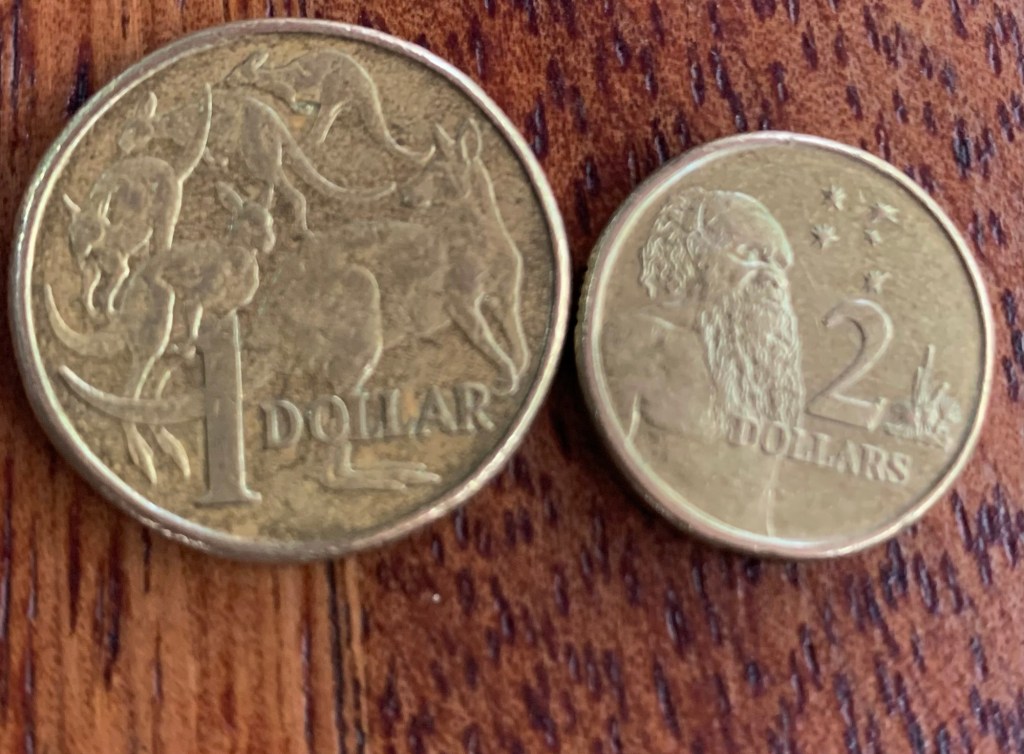
I cannot embrace the local megafauna and I did not buy any stuffed kangaroos or crocodiles, not even a koala. I reported back to JG that the prices for souvenirs were 1/3 to 1/2 the prices in Kuranda, which pleased him because he had pegged it as a tourist trap. The Darwin public toilet did not have soap or paper towels but it did have a sharps disposal slot.  I strolled through empty parks on a Sunday, walked around the wharf, and admired SUV’s kitted out with racks to hold fishing tackle. Why is the AUD 1 coin larger than the AUD 2 coin?

Darwin has been rebuilt twice: once after the Japanese bombed it repeatedly in 1942 and again after Cyclone Tracy flattened the Central Business District in 1975. The Aussies I talked to had a few choice words for me as an American. First, that during the first T—-p presidential administration over 40,000 Americans understandably emigrated to Australia. Second, for the third time I heard that a T—-p could never happen in Australia, where voting is universal and compulsory.   I have modified the name because this is a public blog and a name search by trolling bots would be unwelcome.

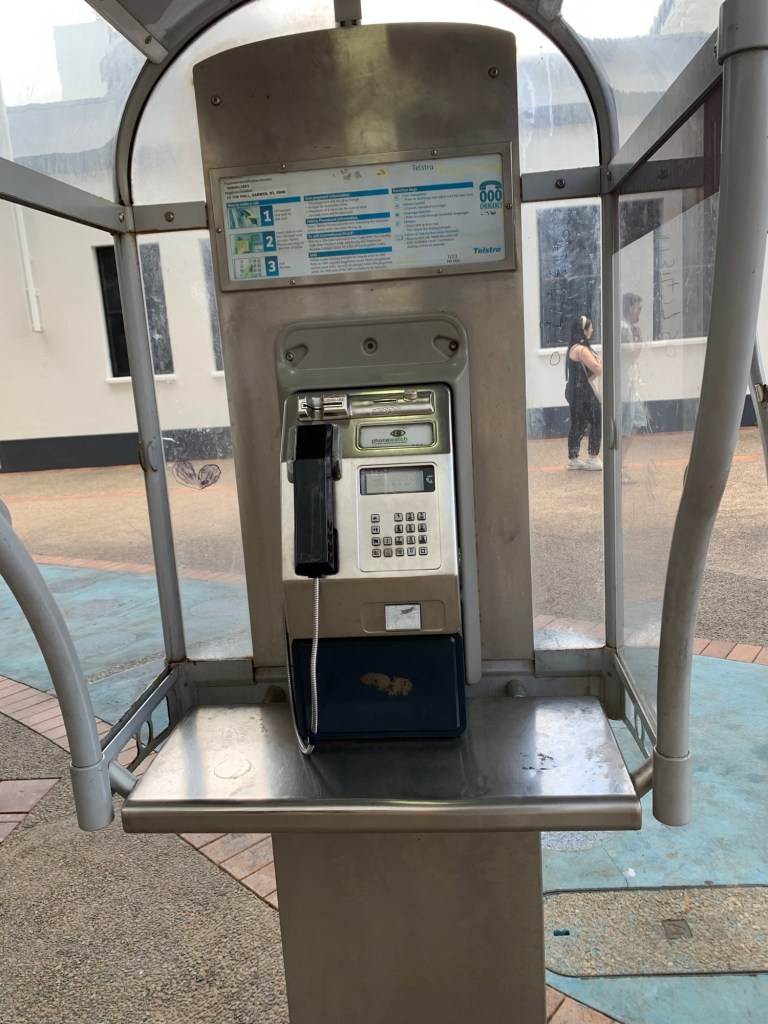
A free phone booth. We had 3 bars so we didn’t need it.

The Aussies deeply believe that everyone loses when only half the eligible electorate votes. I think it’s the wrong half in the USA, but I am touched by Australian democratic fervor. 

WWII Oil Tunnel

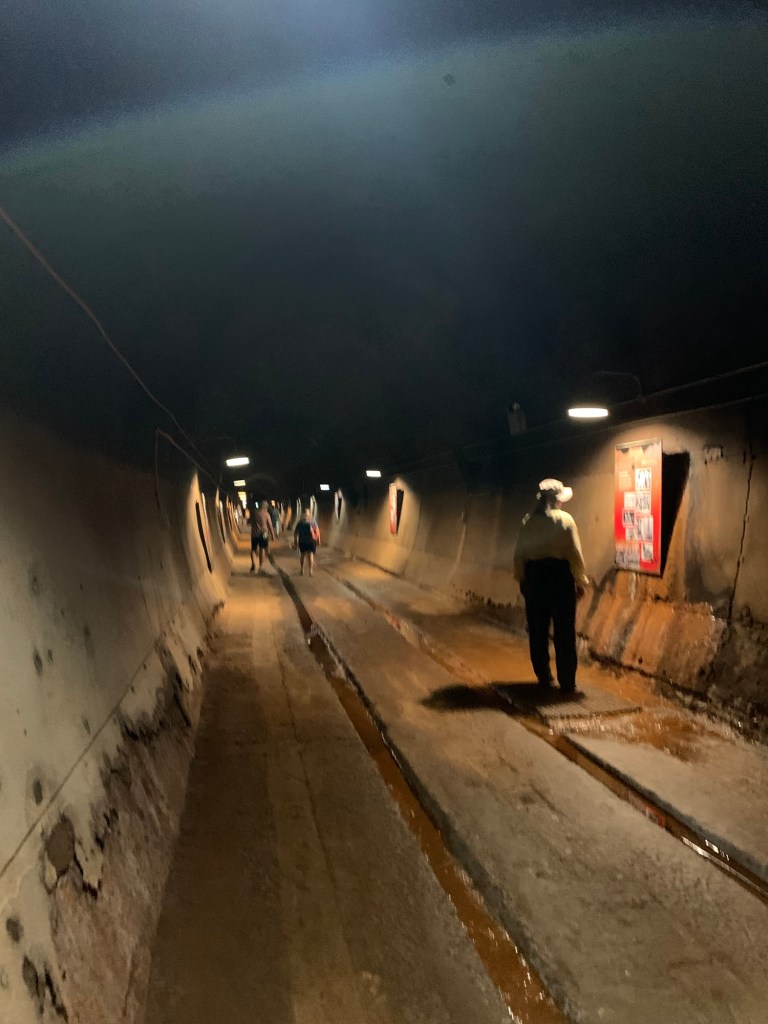
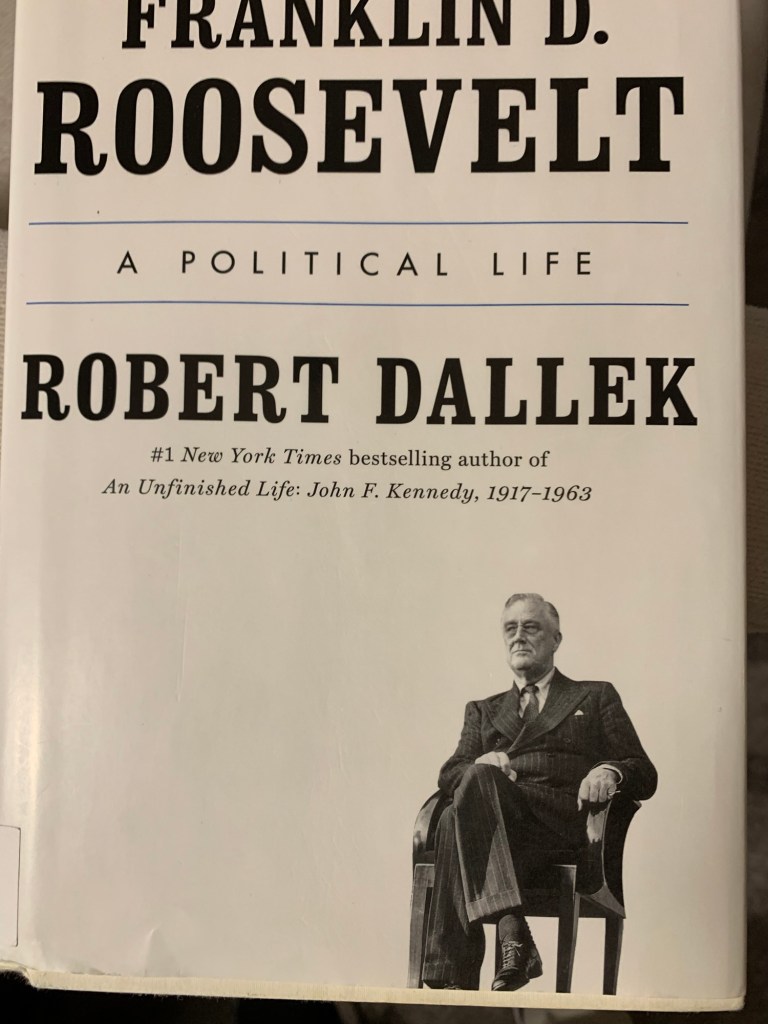
We visited the WWII era tunnels built for oil storage. Within the dark, muggy tunnel we read wall displays about Darwin during the War. The unfortunates of the Royal Australian Air Force got air-bombed and had no anti-aircraft guns to dissuade the Japanese. Building the tunnels was a case of one mistake after another, Murphy’s Law style, but with lives at stake and lost.  On one count there were 700 faulty joints that needed soldering. JG says, “Generals are always prepared to fight the previous war” but also the war leadership in Darwin was inexperienced even by WWI standards. After Singapore easily fell to the Japanese in 1942, 85,000 British, Indian, and Commonwealth soldiers became prisoners of war. Miners, ranchers and fishermen were now supposed defend Australia. The RAF was trying to hold onto the UK while it was being bombed by the Luftwaffe.  I am indignant at how useless our so-called ally was. Chiang Kai-Shek‘s China lily-dipped in the fighting. Meanwhile, JG is reading Robert Dallek’s biography of Franklin Roosevelt, so I can conveniently get my WWII questions answered. 

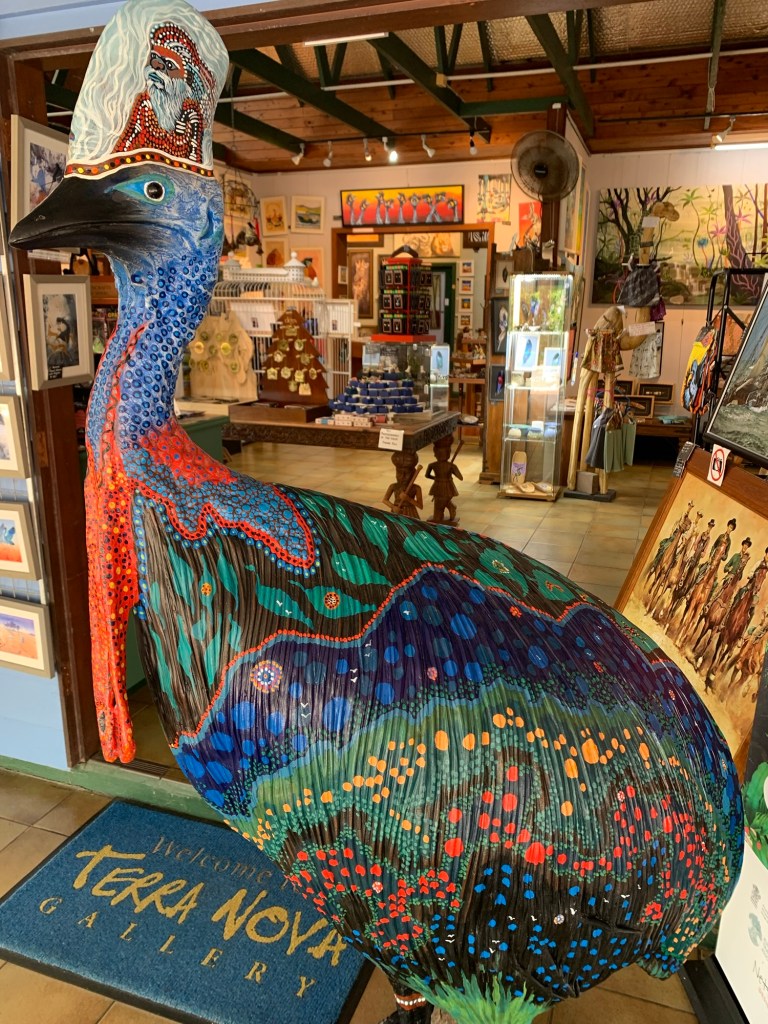
Cairns Aquarium with Cassowary

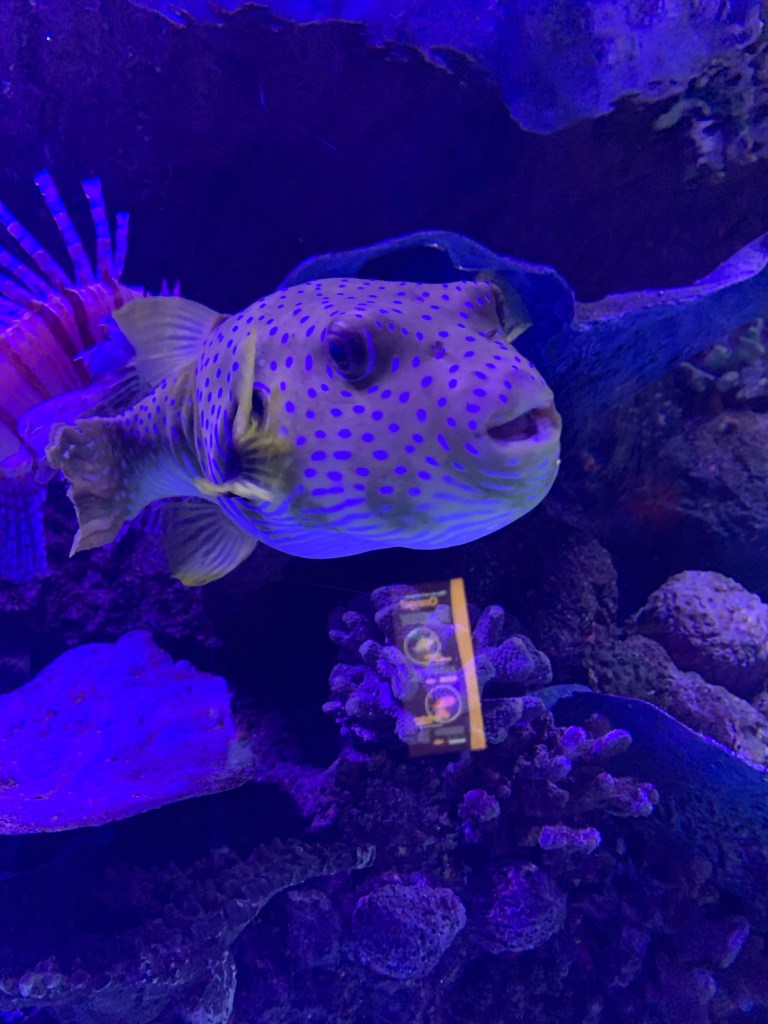
Blowfish: Windbag as Defense

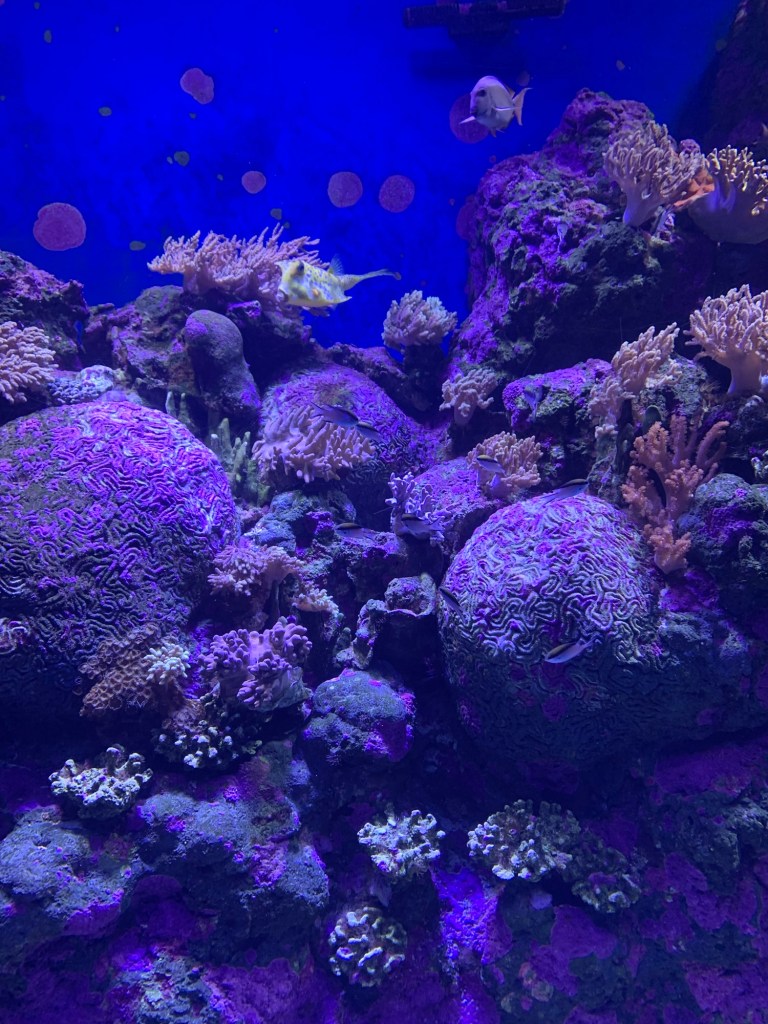
Cairns, pronounced Canes, boasts two UNESCO World Heritage Sites. Since I am on the outs with UNESCO World Heritage anything, I only toss them a reference before moving on. There is an impressive and expensive array of new tourist infrastructure in Cairns. The two World Heritage tourist draws are the Great Barrier Reef and the Daintree Rainforest. Having researched outings to the Reef, we chose a nice safe Aquarium visit: most of the sights and no water up the nose. The saltwater up the nose we can get at home. 

Horned Cowfish

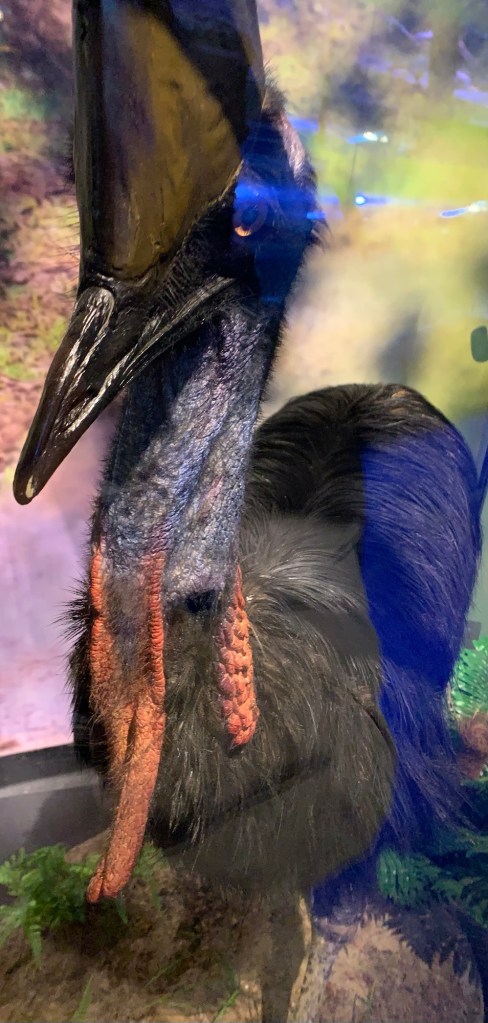
Large flightless birds are an Aussie specialty.

Sorry, Cassowary, no flight for you

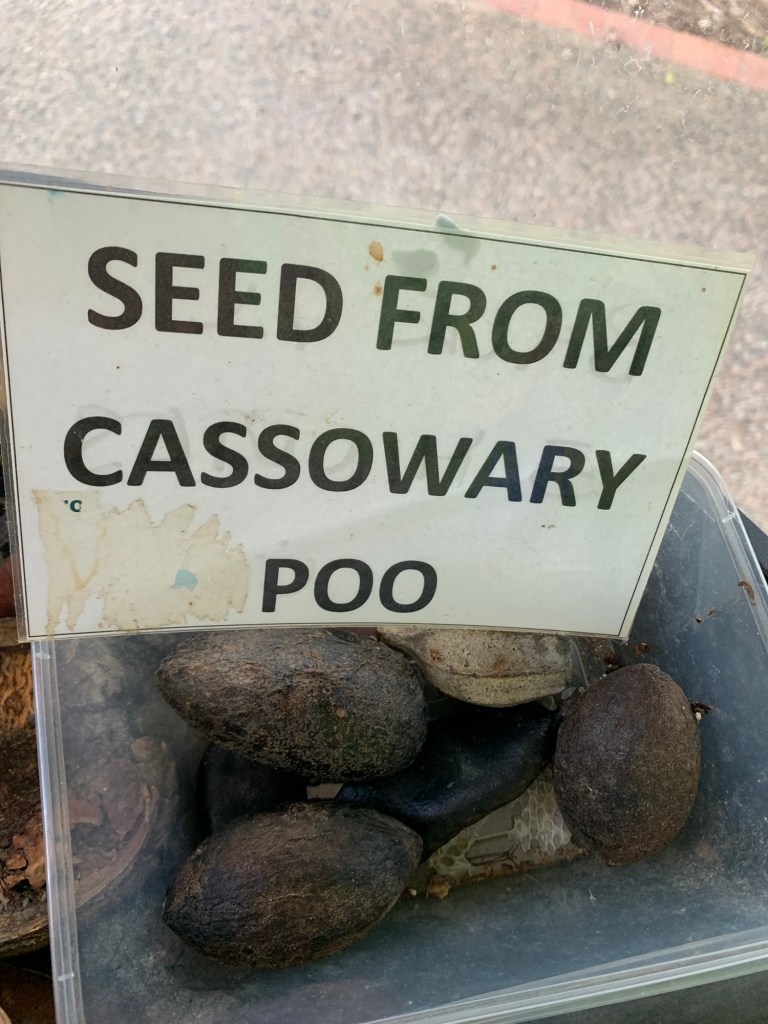
The Aquarium signs told us that a few species of palm only reproduce when the fruit is passed through the Cassowary digestive tract. But a little Google fact-checking https://www.daintreecassowary.org.au/cassowary-foods disproves this rumor. I love it that scientists are employed to sift through Cassowary droppings.  “How was work today, Darling?” “Oh, you know, you’ll never guess what I found in Cassowary poo today!”

Science Triumphs

The Cassowary is also one more resin sculpture in a long lineage. Here’s the Aquarium Cassowary and one duded up Cassowary. 

Feed me dates
In Kuranda

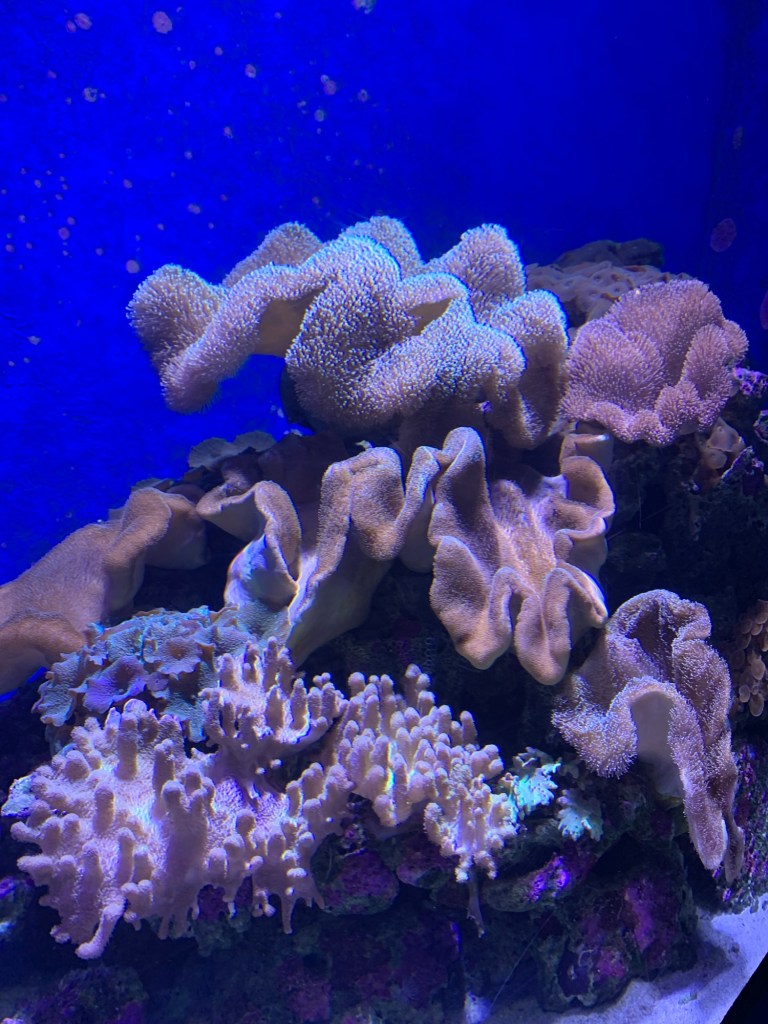
The Great Barrier Reef is so massive it is visible from space. Its denizens are also extra large, compared to the Monterey Bay Marine Sanctuary’s: giant clams, massive fish, anemones like Papa-San chairs. 

Anemones

The fish were well-organized and well cared for. We shared the space with two local mums with prams and toddlers careering about. It reminded me how my brother liked to take his children to Steinhart Aquarium to look at the fish. It was a safe place to practice being a biped.

Despised Lionfish have no natural predator and are a pesty invasive species off the Florida coast. Florida Fish and Game Department regularly offers a bounty on Lionfish, but the USDA says not to eat them, as they are full of ciguatoxins. Lionfish dominate the food chain without challenge, but at least you can’t say the other fish voted Lionfish in as apex predator.

Lionfish Spines are Venomous

Here’s a familiar face from the Marianis Trench:

Anglerfish

Expedition to Kuranda

By Guest Editor John

Esteemed Guest Editor

For our second day in Cairns we took a trip to Kuranda, 30km into the tropical rainforest, 1,000 feet up the mountains. I picked this outing for its fun modes of transportation: a long “Skyrail” ride up the mountain, a good, mostly flat walk around the village of Kuranda, then a narrow gage railway back down. 

 The “Skyrail” was a cable-suspended gondola, made by the same Swiss company that supplies ski resorts. 

Skyrail to Kuranda

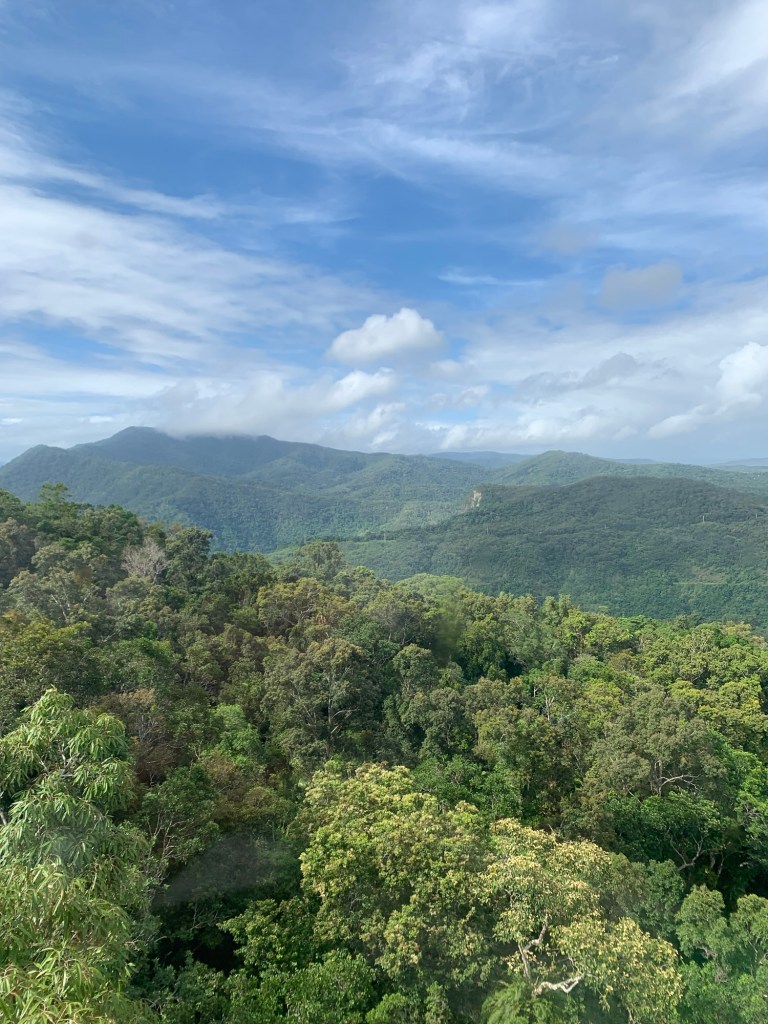
The long ride above the rainforest canopy gave great views. 

From the Gondola

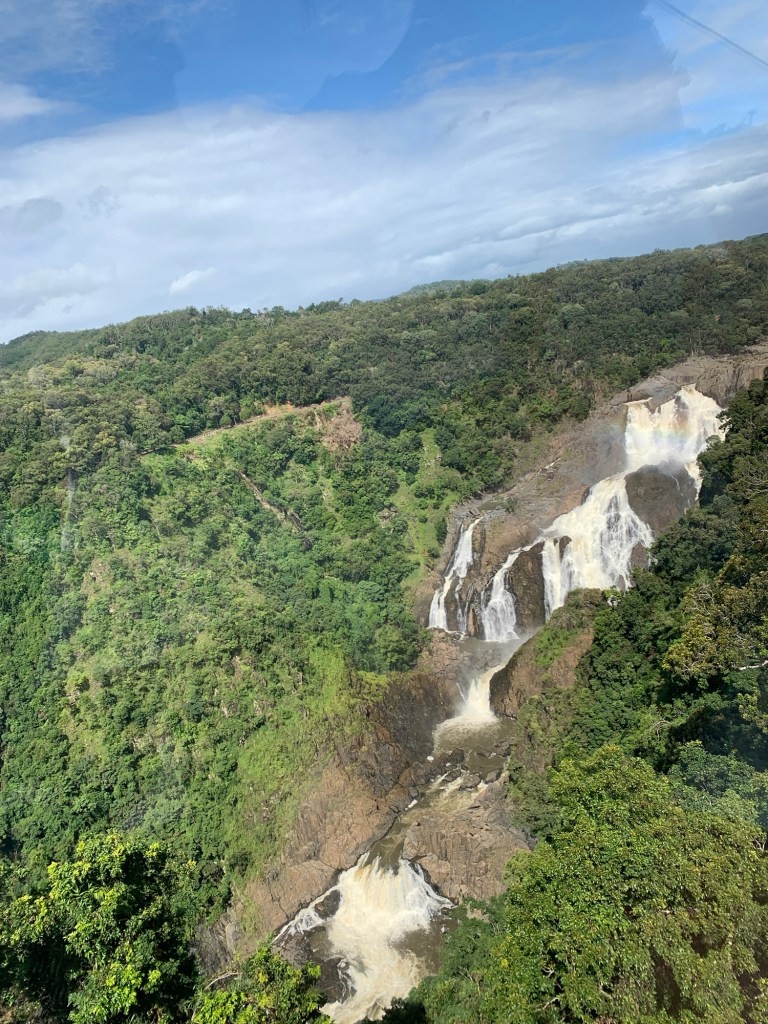
The gondolas ascended above the steep canyon of the Barron River. Intermediate stops along the route allowed us to walk to the canyon edge for dramatic vistas of Barron Falls. 

Barron Falls

The village of Kuranda is a special sanctuary for shops selling Chinese-made refrigerator magnets and for restaurants which don’t expect repeat business. It was cooler there than at sea level, perhaps 80 degrees, though the relative humidity was still in the low triple digits. We walked through gentle, barely noticeable rain. 

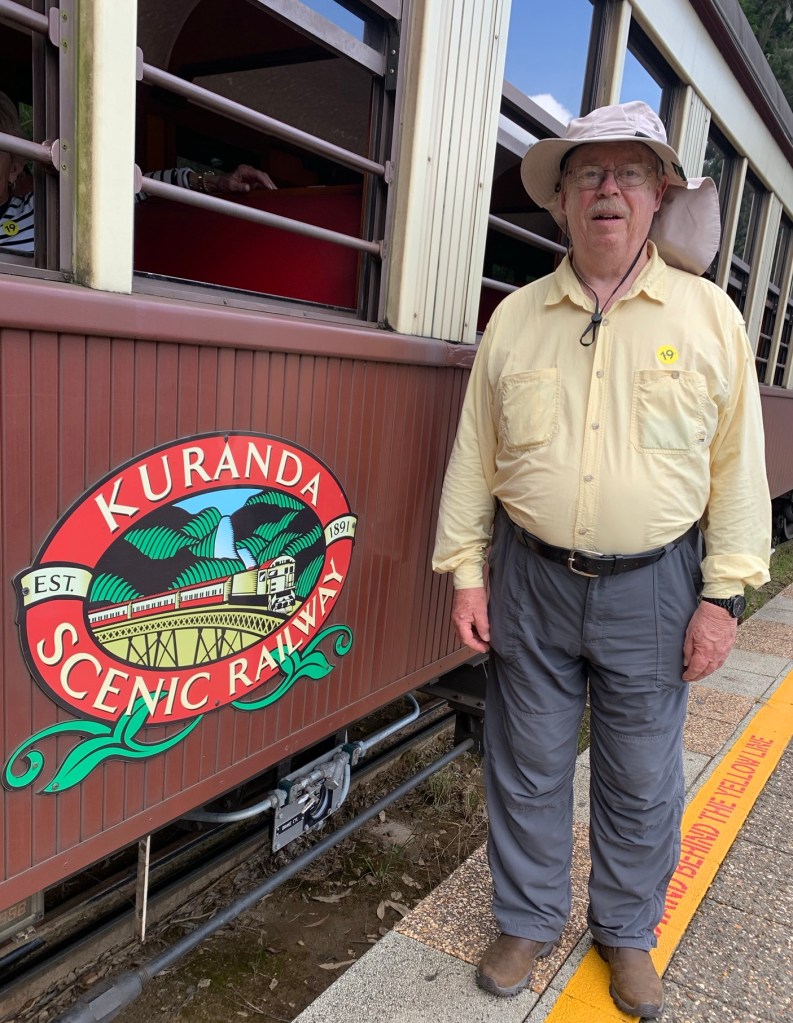
The return trip on the narrow gage railway was the most fun. The carriages were antiques. Ours was one of the newer ones, built in 1936. I was pleased to note that its stainless steel pneumatic break lines appeared to have been recently refitted. The 12-car train was pulled by two very colorful 60-year-old, 1,000 horsepower Co-Co diesel electric locomotives. 

GL-18C Locomotive

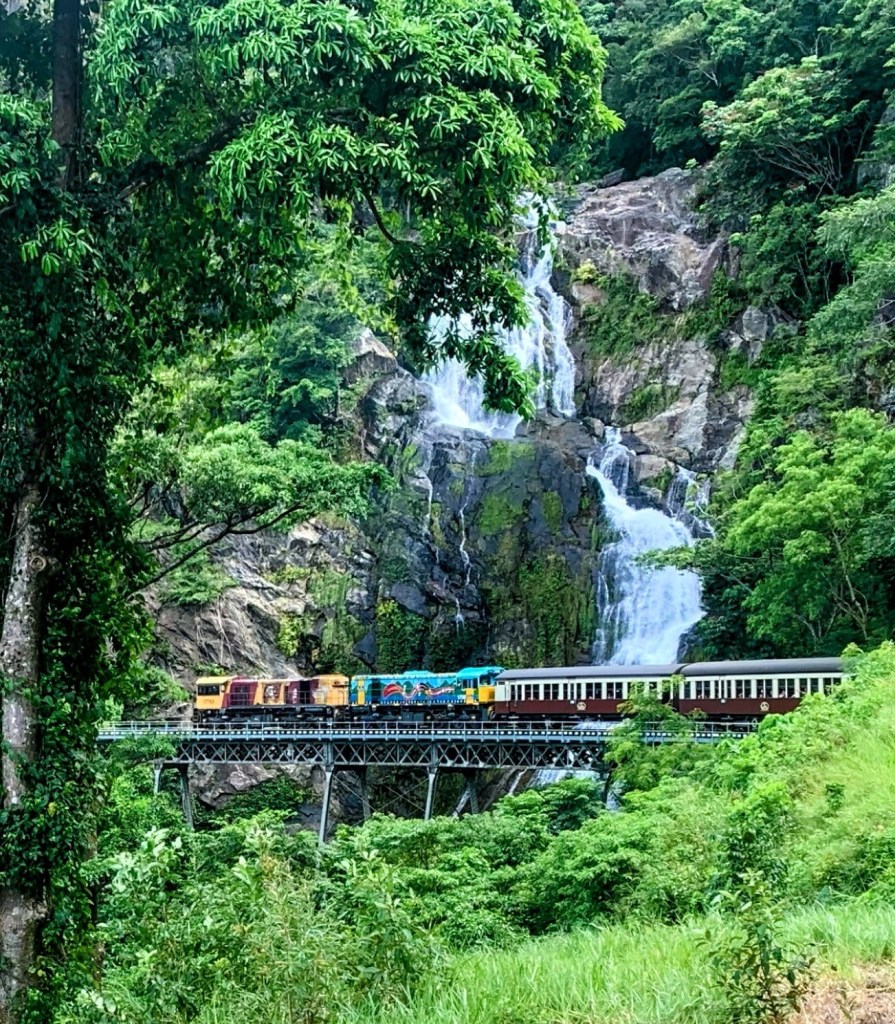
We rattled through the rainforest and along the edge of the precipitous gorge. 

At Stoney Creek Falls

At the station is a monument to the dedicated workers who carved the railway through the mountainous jungle. 

I love it when the engineers are the heroes. 

Fun fact from JN: Australia has no national railroad gage. Each state builds tracks of different widths. 

Airlie Beach, QLD, AU

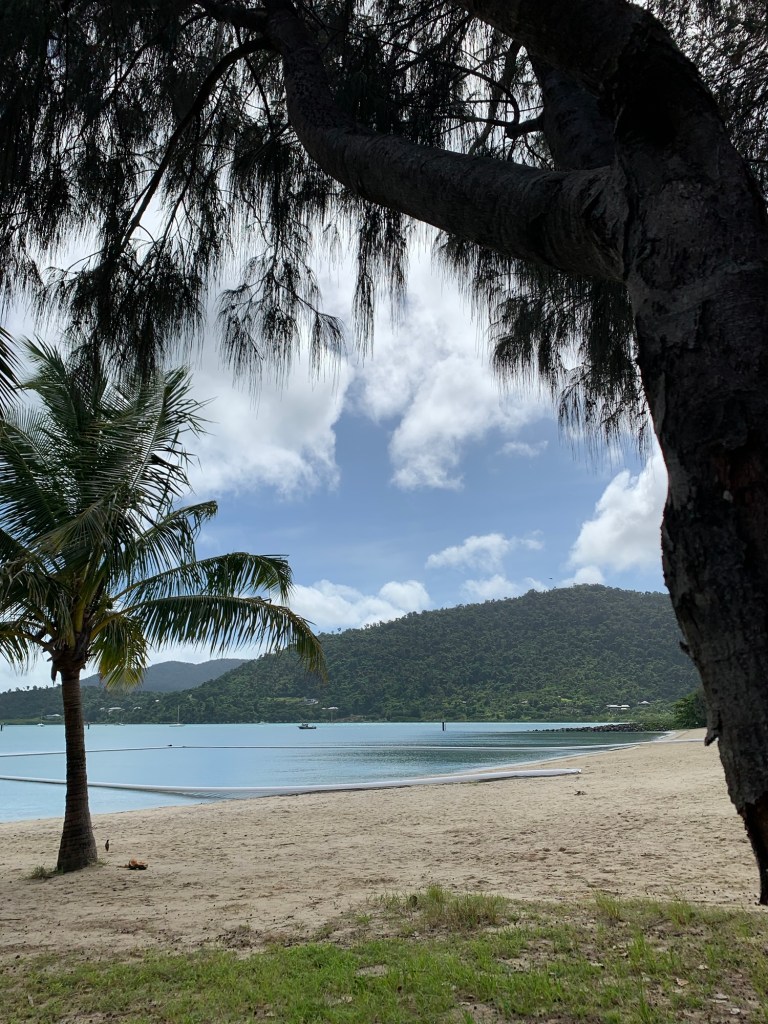
Imported Sand, Planted Coconut Palm

We arrived in the hot, humid gateway to the 74 Whitsunday Islands, known for fishing and diving.

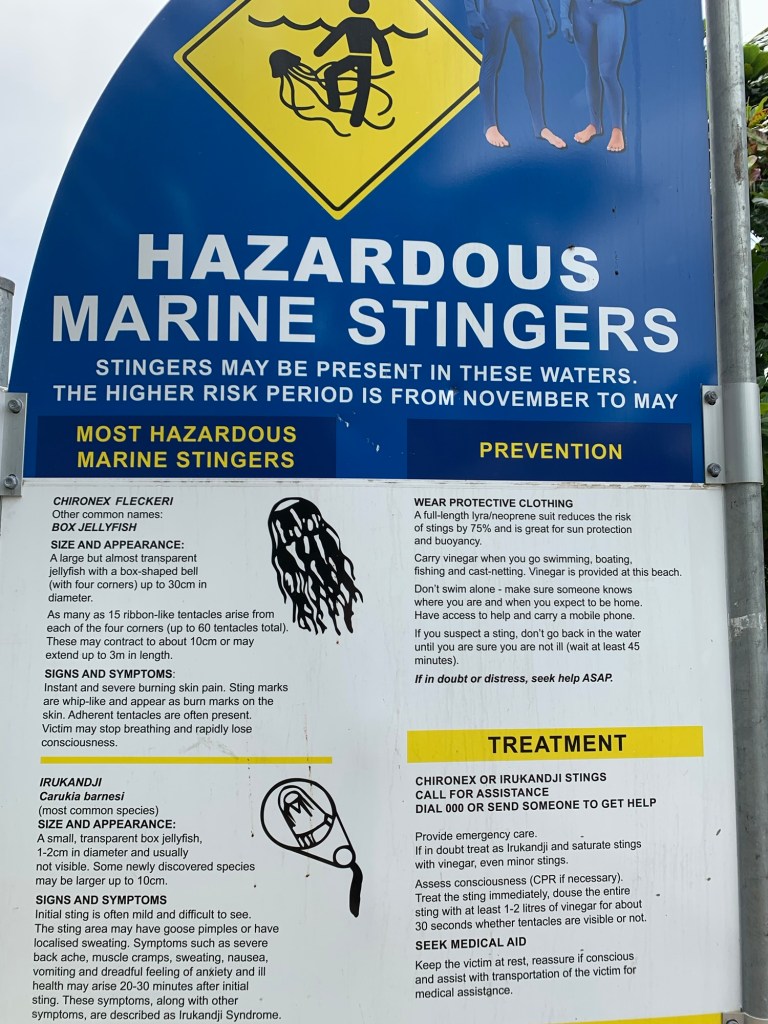
A whole rainbow appeared as we boated in to Shute Harbor. We rode a bus past Conway National Park to a town of marinas, condos, bars and restaurants. Many shops were closed on a Monday. We headed for Beacon Beach, which offered netting against stinging jellyfish. There was a bottle of vinegar as first aid to those who did get stung and calling an ambulance was advised.

I Was Prepared for This

We had the beach to ourselves except for a dingo that wandered by.  They must browse rubbish bins the way coyotes do at home. The South Pacific was calm and warm in the steamy tropical weather. We tag-teamed bathing to keep an eye on our gear. And then we puttered around what town there was. We saw a phone booth touting free calls, but it had been vandalized. On the theme of “wouldn’t happen in Santa Cruz” the cheerful bus driver was sympathetic and helpful, calling in to her boss to ask her colleague to look for a lady’s missing sun hat. If she left it on a bus, the colleague would return the hat to the Security Station at the pier. I saw a man in swim trunks and helmet driving a motorcycle. There must be enforcement of helmet laws here. No birds to report.