

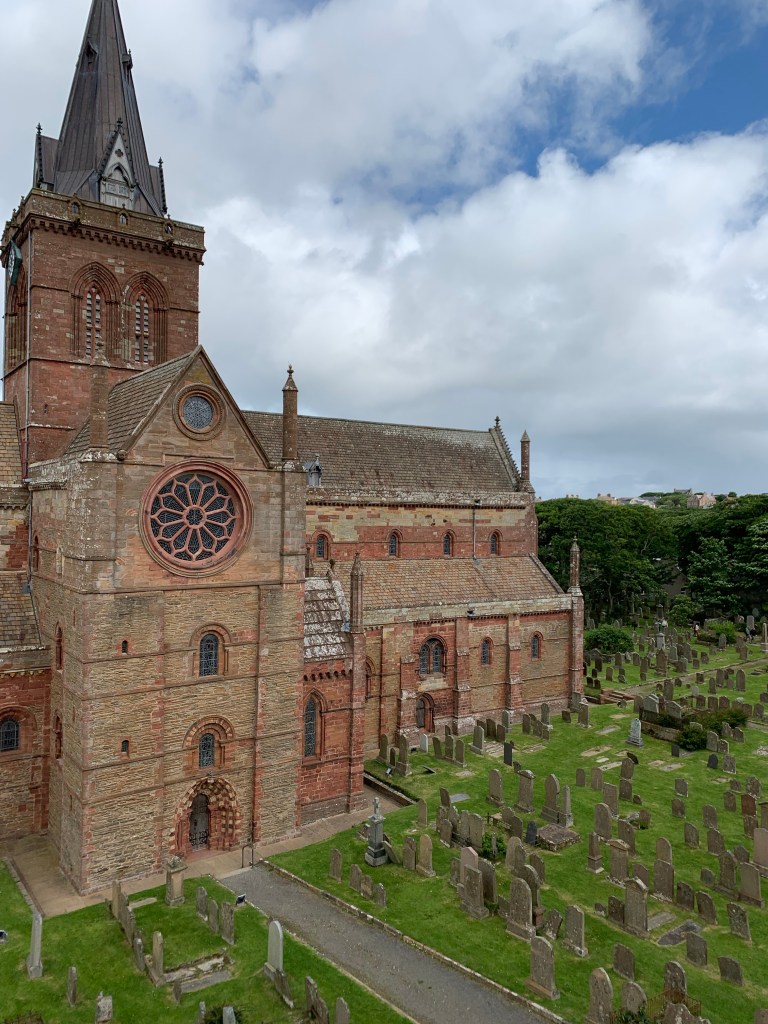
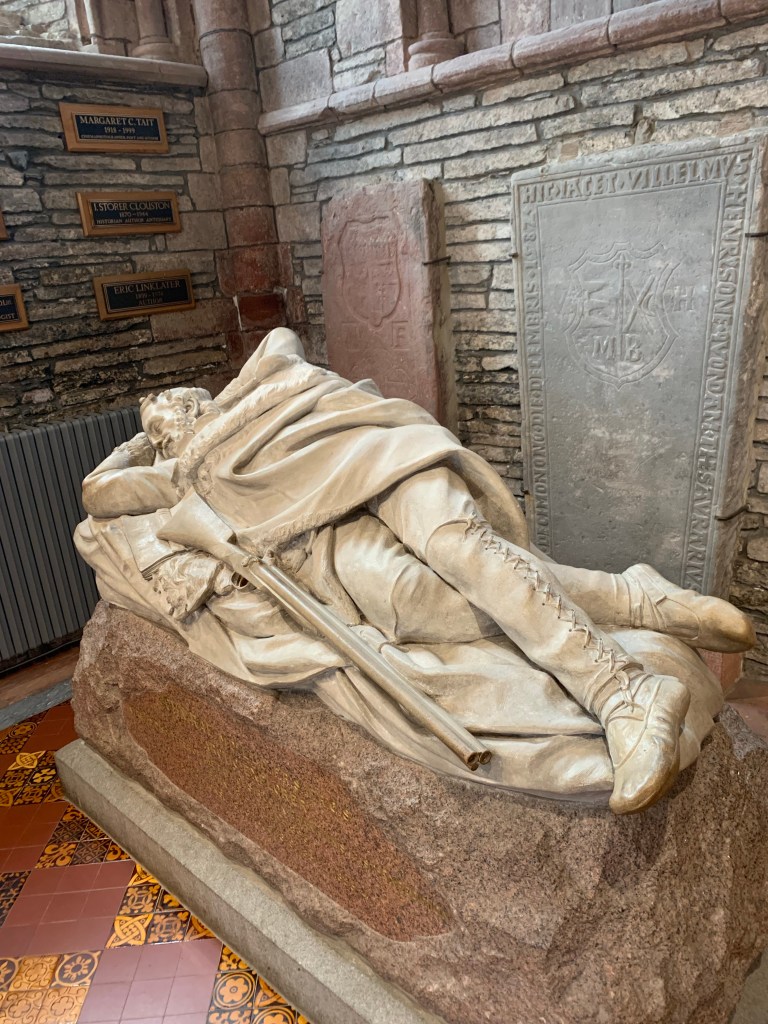

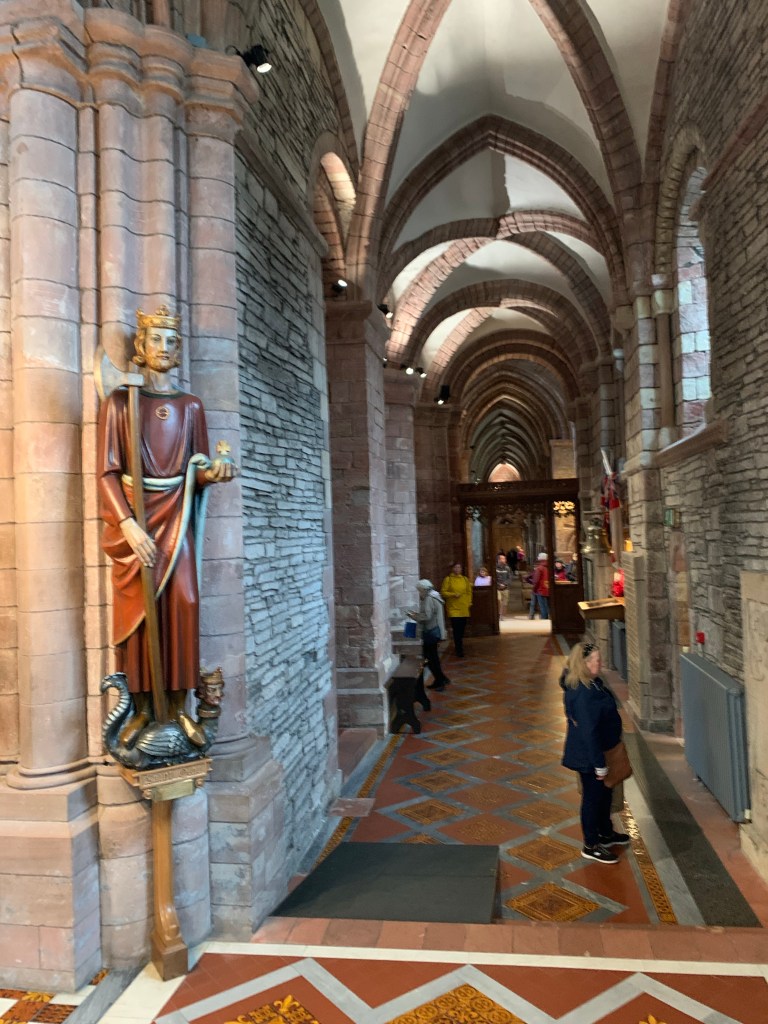
I happen to like visiting temples, cathedrals and churches. Only when I see what matters spiritually to the natives can I form an idea of who they are. Here’s a brief summary of the Church of Scotland.
In the beginning Christian missionaries converted the Celts, Picts, and Vikings. Unlike Roman Catholic saints, early Scottish saints were not martyred for their faith. Instead, they often lived to a ripe old age, preaching and teaching to their flocks. Early Viking saints like Olaf and Magnus were killed by pagan rivals.
After several centuries’ success, Roman Catholicism was called into question by reformers of the 16th century. Along with an explosion in literacy contemporaneous with movable type (Gutenberg Bible 1450’s) and a suspicion that priests who sold indulgences might not be so godly, the first Reformation leaders were motivated to change the Mother Church, not abolish her. But in 1533, when Henry VIII was excommunicated by Pope Clement VII for annulling his marriage to pious Catholic Katherine of Aragon to marry Protestant Anne Boleyn, Henry took the battle to the Pope, claimed all Church property in England for the Crown, and declared himself the Head of the Church of England. In Scotland, King James V was named Defender of the Faith by Pope Clement VII. But when he went to war against Henry VIII, James V lost. But for about 85 years after the death of Tudor Queen Elizabeth, the Scottish Stewarts ruled England, with only a bump in the Divine Right of Kings Road when Charles I was beheaded by Parliamentarians in 1649. In Scotland, the first English royal James is styled “James I and VI” for the sovereign who was spirited away from his mother Mary, Queen of Scots, to be educated as a Protestant and who ascended the throne at age 13 months. The second royal James, styled “James II and VII”, brother of Charles II, converted to Catholicism, and was deposed in favor of William of Orange and Queen Mary in 1688, when James had a male heir, James Francis, who might have founded a Catholic dynasty.
Thanks to the influential preacher John Knox, Scottish Presbyterianism took shape in the 16th century.
Think of the Roman Catholic Church as being structured like a wedding cake: the parishioners on the bottom tier, then above them are the priests, who in turn are obedient to the bishops, who then bow to the cardinals, and then the Holy Father, the Pope, reigns over all. Now think of Presbyterianism as a crocheted afghan of granny squares (credit to M. for supplying the metaphor). The granny-square congregation builds a single self-supporting unit of faith that is also connected, without domination, to others in their faith. Each church was directed by Elders, in Greek Presbytery, who were not more holy than other worshippers, but more sage. I can see the appeal in Spend Local, Decide Local, Pray Local. The Scottish did not want to swap one Holy Father at the tip of the wedding cake for another.
And what do these Christians believe? They believe in God and in the Sacraments. John Knox adapted stern Calvinism, that God chooses some for salvation and some for hellfire, into a theology of believers striving to do God’s Will and God bestowing Grace upon them. For some reason, this theology reminds me of the game of golf. Golfers keep striving, striving to sink the ball in the hole. Yet they’re continually reminded how inept and clumsy they are, with no excuses for their bad shots. Knox espoused an “only yourself to blame” attitude. This is not predestination, in which you bear your present suffering and hope for better times in Heaven as part of God’s vast plan. This is maximum Divine judgment with minimum Divine relief.
What if you think God’s sublime Will is unknowable without the Holy Mother Church as Intercessor? You’d be a Catholic.
But back to Church of Scotland. Theirs is a flexible, functional Christianity for the literate. And since the 1707 Act of Union they are allowed their differences with the Anglican Church. But attendance is falling off. Many churches were locked. They’ve become event spaces rather than sanctuaries. The churchyards are full. The pews, not so much.
I have a special fondness for the Presbyterians. I can’t forget that JG attended and later rejected the Presbyterian Church. So the person I love has been shaped by this faith. That is a close-to-home connection.


 JohnandJanet'sJourney
Thank you for this summary! Love, T
LikeLike