
Okanagan Falls, or sx̌ʷəx̌ʷnitkʷ , is pronounced “s’hoch’neet” and means “little falls.” The Nsilxcim (pronounced Skeltchen) word is coming back into use, thanks to the Okanagan Nation, who are the S’yilx (pronounced s’yil h). Sure, its spelling is not for sissies. But consider the crimes committed by the European settlers, not least was forbidding Native children to speak the language of their people. Reparations are in order, and because of my European descent I will learn some of their language. I will refrain from snark about their aversion to vowels. The apostrophe signals a glottal stop. In Osoyoos, pronounced O-sue-yuss, we plan to benefit from the hospitality of the First Nations again, after Kah Nee Ta, by staying at the Nk ‘Mp (pronounced Ink a Mip) RV Park. We like to spend our tourist money on locals. You can’t out-local the First Nations. My father used to say he couldn’t be out-oldtimered in Santa Cruz. That’s because the Costanoan Indians weren’t around to gainsay him. One fascinating aspect of our trip through the Pacific Northwest has been more prominent evidence of native tribes.
The Okanagan lakes, river, and grasslands are like nothing in Santa Cruz. Broad and swift through the hills, then flattening to marshlands, the river supports diverse ecosystems. Mega fauna like grizzlies and moose browse here. We were excited to see moose above the Columbia, on Highway 3, between Warfield and Rossland. The locals treat them the way we treat mule deer: great big garden pests and road hazards.
We stopped in at the Creston Valley Wildlife Management Area’s Discovery Centre. The CVWMA former nature center closed in October 2017 due to lack of funds. We visited a small trailer used for outdoor education about the 7,000 hectares (one hectare equals 2.47 acres) of wetlands overseen by the CVWMA, now funded in part by BC Hydro, the power company. On the trail, I spotted a snake before leashed Marco did. It was a kind I’d never seen in California: about 24 inches, grayish-yellow, under a tree near the swamp. Thanks to the internet I identified it later: an Eastern Racer, Coluberconstrictor. Venomous but not deadly.
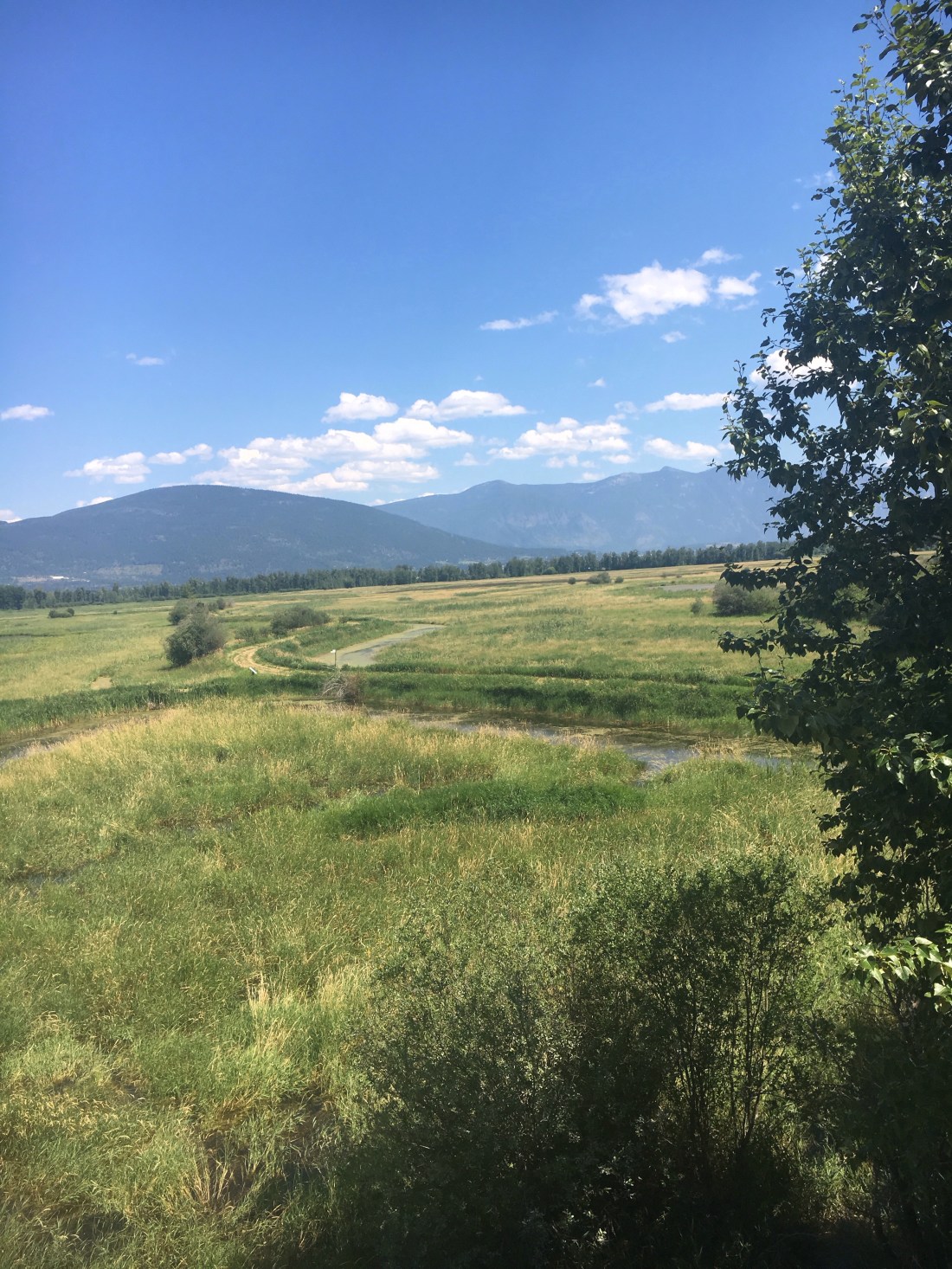
I appreciated the outdoor education materials. Here’s a nifty mnemonic, courtesy of our BC swamp educators: Sedges have edges, rushes are round, grasses have segments and roots in the ground.” Here you see how expansive the wetlands are around Creston:
 JohnandJanet'sJourney
It looks so flat and grassy. I’m not used to seeing so much wetland that distinguishing between sedges, rushes, and grasses becomes a practical problem. What a cool landscape! Congratulations on your moose sighting.
I’m glad the linguistic revival efforts are working and I’m glad you’re finding local businesses to patronize.
LikeLike
I agree, I love the wetland scene! Very different from CA or from the extensive swamplands in the Southeast! I appreciate your effort in transcribing and transliterating the First Nations names!
LikeLike